
European Roulette at UK Online Casinos: Rules and Play
 Available in GB
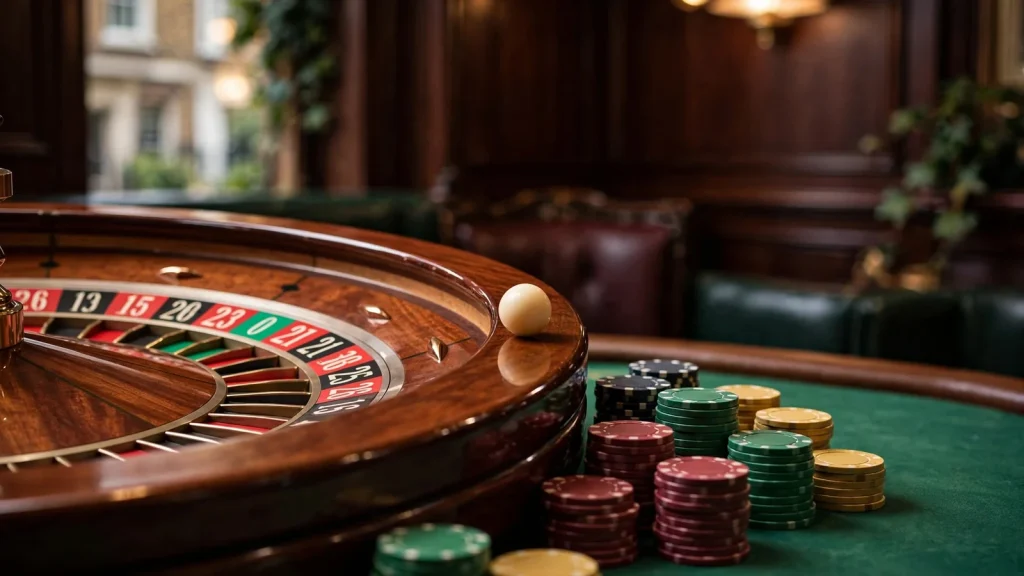
A guide to European roulette’s single-zero wheel, betting options and the differences between online spins and live tables.
Table of Contents
- The European Wheel: Thirty-Seven Pockets, One Zero
- What “Best” Means When the Wheel Is Random
- Placing Bets: Payouts, Systems and the Limits of Prediction
- Finding the Wheel Online: RNG Spins and Real Dealers
- Single Zero, French Rules and the Shape of a Bet
- Free Spins, Real Money and the Rules Around Play
- Reading the Roulette Table Layout
- Roulette-Themed Slots Are a Different Kind of Game
- Live Roulette: Dealers, Pace and Table Minimums
- European and American Roulette: The Extra Green Pocket
- Jackpoty live casino
The European Wheel: Thirty-Seven Pockets, One Zero
European roulette turns around a compact piece of arithmetic: thirty-seven pockets, numbered from 1 to 36, with a single zero alongside them. The wheel does not know which number has appeared before, and its construction gives no previous result a claim on the next spin. Each new turn begins with the same physical arrangement and the same uncertainty. That small green pocket is not decoration. It is part of the game’s mathematics.
The wheel’s circular form makes chance visible. A ball travels around a rim, loses speed, meets deflectors and eventually settles into one pocket. The movement looks like a sequence of causes that might be read: the force of the spin, the ball’s path, the points where it strikes the wheel. But a visible sequence is not the same as a dependable forecast. Tiny differences in motion can matter, while the result remains uncertain until the ball comes to rest. The ceremony is precise; the outcome is not.
On an online casino European roulette table, the same basic idea is represented through the game’s wheel and its numbered outcomes. The screen may make the process look clean and legible, but the defining structure remains thirty-seven possible pockets, including zero. European roulette casinos offer different presentations of that structure, yet the standard game’s central feature is not a particular room, soundtrack or dealer. It is the single-zero wheel.
Zero has a peculiar social role. It is neither red nor black, neither odd nor even, neither high nor low. Its presence interrupts the categories that organise the numbered field. Those categories make roulette feel orderly: the eye can sort, group and anticipate. Zero sits outside that reassuring pattern. The wheel has made room for an exception, and the exception is where the casino’s mathematical advantage is housed.
Live Dream Catcher Casino UK: Format Guide
That advantage is expressed as the house edge: 2.70% in European roulette. The figure describes the game’s built-in statistical margin over repeated play, not a deduction made visibly from every individual spin. A single result may produce a win or a loss; the edge is not a prediction of what will happen in the next round. It is a property of the rules across play over time. Chance remains capable of short-term surprises. The arithmetic is patient.
This distinction is easy to miss because roulette presents outcomes one at a time. A number arrives, the wheel resets, and attention narrows to the latest result. A run of similar outcomes can seem to acquire a story, as if the wheel were due to correct itself or had settled into a habit. Yet the preceding spins do not alter the pocket structure of the next one. The apparent narrative belongs to the observer, not to the mechanism.
The single zero matters because the numbered outcomes are not the whole story of the wheel. If every pocket represented a player-facing category and there were no exception, the balance between those categories would be different. Zero supplies the house with an outcome that does not fit the familiar divisions. The result is a game whose surface offers patterns while its underlying structure preserves a margin for the house.
That is one reason roulette has lasted as a casino image. It turns an abstract probability into a public event: a moving ball, a visible wheel and a brief pause before the result becomes fixed. The player does not have to understand the mathematics to recognise the ritual. But the ritual can make chance feel personal, almost conversational, as though the wheel were responding to attention. It is not. The wheel has no memory to consult and no intention to reveal.
European roulette features a single-zero wheel with thirty-seven pockets, resulting in a house edge of 2.70%.
The simplicity of the European wheel can therefore be misleading. Thirty-seven pockets are straightforward to count; the implications of the zero are less immediately apparent. The 2.70% edge is not a promise of steady losses, nor does it mean that a particular session will follow a smooth pattern. It marks the structural advantage built into the standard game. Individual outcomes may wander far from any tidy expectation before the long view becomes meaningful.
For European roulette casinos in the UK, the draw is partly this tension between a stable design and an unstable result. The rules establish a fixed field; chance supplies the movement within it. Each spin looks like a fresh little drama, although the wheel itself has no plot. That is the game’s quiet trick: it gives randomness a stage, then lets people search the performance for signs of intention.
The wheel offers no such signs. Only pockets, a ball and the zero.
What “Best” Means When the Wheel Is Random
When choosing a UK casino for European roulette, it helps to check practical details as well as the game itself. This list notes the payout-speed information available for each operator.
1. NightLuck
Payout speed: 1-3 business days NightLuck is listed with a stated payout speed of 1–3 business days.
2. x3bet
Payout speed: 1-3 business days x3bet has a stated payout speed of 1–3 business days.
3. Chanze
Payout speed: 1-3 business days Chanze is listed with a stated payout speed of 1–3 business days.
4. Amunbet
Payout speed: 1-3 business days Amunbet has a stated payout speed of 1–3 business days.
5. BeOnBet
Payout speed: 1-3 business days BeOnBet is listed with a stated payout speed of 1–3 business days.
6. SlotoSport
Payout speed: 1-3 business days SlotoSport has a stated payout speed of 1–3 business days.
7. SpinFormula
Payout speed: 1-3 business days SpinFormula is listed with a stated payout speed of 1–3 business days.
8. Zombillion
Payout speed: 1-3 business days Zombillion has a stated payout speed of 1–3 business days.
9. Britsino
Payout speed: 1-3 business days Britsino is listed with a stated payout speed of 1–3 business days.
10. NightWin
Payout speed: 1-3 business days NightWin has a stated payout speed of 1–3 business days.
“Best” can sound like a promise about the wheel. It is not. A casino cannot make a roulette result more favourable by presenting the game in polished graphics or placing it beside a generous-looking offer. A useful comparison is less glamorous: whether the game’s return information is easy to find, whether the terms are intelligible, and whether the operator sits within the safeguards that apply to British gambling.
RTP, or return to player, describes the theoretical proportion of stakes returned over a very large number of plays. It is not a forecast for an individual session, and it does not tell a player what will happen next. For a roulette game, the information should be accessible before play, not buried behind a maze of menus. The stated figure should relate to the particular game and rules on offer; a general claim about a casino’s games tells little about one roulette table.
That distinction matters because “best European roulette casino” is not a meaningful odds category. The wheel’s mathematics does not improve when the operator changes. What can differ is the clarity of the information around it: whether rules and RTP are visible, whether the table’s format is described accurately, and whether bonus conditions make sense before bonus funds are accepted. The useful comparison is between terms, not promises.
Bonus wagering deserves close reading. Most UK operators count roulette wagers at 10% to 20% towards the requirement attached to bonus funds. The contribution can vary by game and operator, so a headline offer says little about how much roulette play will count. A specialist review has reported a distinction in which live roulette counts at 10% or 20%, while RNG roulette counts at 100%; those figures should be treated as that review’s account, not as a universal rule. The operator’s own current terms are decisive.
Live Roulette in the UK with English-Speaking Dealers
The percentage is only one part of the calculation. Terms can define which roulette games qualify, whether live tables are excluded, and how bonus funds are treated alongside deposited money. A low contribution rate means that a wager adds little towards completing a wagering requirement; a higher one can make progress faster, but does not turn the wager into a better bet. Conditions should be read as conditions, not as a second balance waiting to be withdrawn.
The regulatory frame is less optional. The UK Gambling Commission is the sole regulator of online casino activity in Great Britain. Remote operators serving British customers must hold the relevant UKGC licence; a platform without a valid UKGC licence cannot legally offer real-money live roulette to British residents. A licence is not a certificate that every offer is attractive. It is the basis for legal operation and oversight.
The protection attached to that framework is practical rather than decorative. UKGC-licensed live casino operators must offer deposit limits, loss limits, session time reminders, reality checks, cool-off periods and GamStop self-exclusion. Operators must also verify age before allowing a customer to deposit. New customers must be prompted to set a financial limit before their first deposit, with account-level limit controls available thereafter. These measures do not alter roulette’s chance element; they place boundaries around the account and the time spent using it.
Legal Compliance
Remote operators serving British customers must hold a valid UK Gambling Commission (UKGC) licence to legally offer real-money live roulette.
A cautious comparison therefore begins with accessible game information and ends with the terms that govern the account. The UKGC public register can be used to verify a licence before depositing. Licensed casinos must also provide an internal complaints process and access to an approved Alternative Dispute Resolution service. If an offer’s wagering language is opaque, or the game’s return information is difficult to locate, that is not a small-print puzzle worth solving by guesswork. It is a reason to pause.
The word “best” is most useful when stripped of its sales meaning. It may describe a clear interface, comprehensible rules or terms that suit a player’s preferences; it cannot mean a wheel that is more likely to cooperate. Randomness is remarkably indifferent to branding.
Placing Bets: Payouts, Systems and the Limits of Prediction
Playing European roulette online begins with choosing where a stake should sit before the spin. A bet can cover a single number or a wider group; the narrower the selection, the less often it wins, while the payout is correspondingly larger. That is a description of the game’s payment structure, not a way to make any result more likely.
A straight-up bet selects one number and pays 35:1 if it wins. A split bet covers two adjacent numbers and pays 17:1, while a street bet covers a horizontal row of three and pays 11:1. These are inside bets: their small coverage gives them a more dramatic return when successful, but they are exposed to many losing outcomes.
Outside bets spread the stake across broader categories. Red or black, odd or even, and high or low each pay 1:1. Their payouts are smaller because they cover more possible results, not because they can steer the wheel. The distinction is useful when deciding how much volatility a session can tolerate; it does not change the underlying chance of the next spin.
Live Baccarat Online in the UK: Rules and Tables
What a betting system can—and cannot—do
Systems impose a pattern on staking. The Martingale, for instance, calls for doubling the stake after every loss, with the intention of recovering earlier losses when a win eventually arrives. The arithmetic is tidy. The table is not obliged to cooperate.
A losing streak can eat into a player’s bankroll, and successive increases make the cost of continuing rise quickly. A system cannot remove that risk by arranging bets in a memorable sequence. Nor does a run of one colour, number range or parity category make the opposite result due. Each roulette outcome is determined by chance; no strategy can predict the final result.
This matters because repetition can feel like evidence. A player may see a pattern in recent spins and treat it as a signal, or may take a previous loss as a reason to stake more. Neither response changes what the next result will be. A staking plan can help define how a person intends to bet, but it cannot turn uncertainty into information.
The practical decision is therefore less glamorous than the systems suggest: choose a stake that can be lost without upsetting the rest of the session, and avoid treating a payout as a forecast. Online play makes it easy to place another bet immediately, so the pause between intention and action can be brief. That is precisely where a fixed limit has a use—not as a winning formula, but as a boundary.
The table offers several ways to arrange a wager, from a single number to broad even-money categories. Each has its own payout and pattern of risk. None gives the player privileged knowledge of the ball’s destination. Roulette permits choices. It does not permit prediction.
Do
- Choose a stake that can be lost without affecting the session
- Use fixed limits as a boundary for the account
Don’t
- Treat a payout as a forecast for future results
- Assume a betting system can remove risk or predict outcomes
Finding the Wheel Online: RNG Spins and Real Dealers
An online European roulette game can present the same familiar wheel in two quite different ways. In one format, software generates the result; in the other, a camera carries a studio table into the browser. The distinction is not merely decorative. It changes what appears on screen, how a spin unfolds and what kind of evidence the player sees before the next decision.
With RNG roulette, a random number generator simulates each spin. The wheel and ball may be shown as animation, but the result is produced digitally rather than by a physical ball travelling around a physical wheel. That makes the format self-contained: no dealer or studio feed is needed to stage the round. Spins can move quickly, and minimum stakes can be low, with some games starting at 10p. For anyone looking at an online casino with European roulette, this is the compact, software-led version.
The animation is a representation, not a window onto a hidden mechanical event. That distinction matters less to the game’s basic identity than to its presentation. A rendered ball may circle a rendered wheel, but the visual sequence is there to show a generated result. The screen turns computation into ceremony.
Live dealer roulette takes the opposite route. A real wheel sits in a studio; a human dealer sets the round in motion, and a physical ball drop determines what is shown. The game is streamed to the player, so the wheel is not an animation standing in for a physical object. It is a physical object, viewed remotely. The dealer’s presence also gives the round a visible sequence of actions rather than a software-generated display.
Monopoly Live Casino UK: How Online Play Works
That does not make one format more predictable than the other. The difference is how the event reaches the screen, not a promise that one kind of wheel can be read or anticipated. RNG play offers a direct digital presentation; live play preserves the studio setting and human procedure. A European roulette wheel with a green zero can appear in either format, but the green pocket alone does not tell whether the image is simulated or streamed. The game label and format details do that work.
For British players, the distinction also has a regulatory boundary. A platform without a valid UK Gambling Commission licence cannot legally offer real-money live roulette to people in Britain. UKGC-licensed live casino operators must provide deposit and loss limits, session time reminders, reality checks, cool-off periods and GamStop self-exclusion. The streamed table may look like a small studio visit; the account behind it remains part of a regulated gambling service.
Neither format needs to be mistaken for a different game simply because one is animated and one is filmed. Online casinos with European roulette may offer a simulated wheel, a live studio table, or both. The useful question is what kind of event the screen is showing: a generated outcome dressed as a wheel spin, or a real ball dropping on camera. One is software’s theatre. The other has a stage.
Single Zero, French Rules and the Shape of a Bet
A single-zero table gives the green pocket a disproportionate role in the game’s arithmetic. The betting choices are arranged around numbers and groups of numbers, but the zero does not belong to the red or black set, nor to either side of the usual even-money divisions. That small patch of green is where the apparent simplicity of a broad bet meets the house rules.
Inside Bets
Specific choices on the numbered grid, such as straight-up, split, or street bets, offering higher payouts for narrower coverage.
Outside Bets
Broader categories such as red/black, odd/even, or high/low, which cover more results with lower payouts.
Zero
An exception that falls outside the standard categories of red/black, odd/even, or high/low.
The table’s numbered grid invites close, specific choices: a wager may sit on one number or cover a small cluster. These are called inside bets because they occupy the numbered field. Outside bets sit beyond it, covering wider categories such as colour or parity. The distinction is spatial, but it also describes a difference in reach: one kind selects a narrower portion of the layout, the other a broader one. Neither changes what the wheel can do.
On a single-zero wheel, zero is the awkward exception to many outside bets. Red or black, odd or even, and low or high appear to divide the numbered field neatly, yet zero falls outside those divisions. Without a special rule, it can make an even-money wager lose in full. The green pocket is therefore more than a colour cue: it marks the point at which the table’s categories stop being tidy.
La Partage changes that result for even-money bets. If the ball lands on zero, half of the stake is returned rather than the whole wager being lost. This reduces the house edge on those bets to 1.35%. The rule does not make the wheel predictable, or turn a broad wager into a guarantee; it changes the financial consequence of one particular outcome.
That is a small alteration with a large effect on the meaning of the bet. A player choosing red or black is not simply choosing between two colours. The choice is made under a set of rules that decides what happens when the ball lands outside both. On a table without La Partage, the zero has one consequence; on a table with it, the same pocket is treated differently for eligible even-money wagers. The wheel has not moved. The contract has.
Live Blackjack Online Casinos in the UK: How It Works
French roulette adds En Prison alongside La Partage. Together, these rules give French roulette the lowest house edge among standard variants. The difference comes from what happens to certain wagers when zero appears, rather than from a different way of spinning the wheel. The name “French” can suggest an ornate tradition; the practical point is more restrained. A rule at the table changes the cost of the green pocket.
This makes the betting surface worth reading as a set of conditions, not merely a menu of choices. A familiar outside bet can carry different consequences under different rules, while an inside selection remains a narrower wager on the numbered field. The labels alone do not settle the matter. The treatment of zero does.
There is no mystery in that distinction, though casinos have often made rules look like scenery. The green square is small. Its terms are not.
Free Spins, Real Money and the Rules Around Play
A free-play version of European roulette can show how an online table works without putting cash at stake. It is a practice mode: outcomes do not create winnings that can be withdrawn, and the balance displayed there is not a real-money account. A European roulette demo may be useful for learning the interface, but it cannot reproduce the financial consequences of a real session.
Attention: A European roulette demo is a practice mode for learning the interface and does not reproduce the financial consequences of real-money play.
The distinction matters because a game can look much the same in both modes while the stakes are not. Real-money European roulette involves deposits and gambling losses; demo play does not. Nor is a roulette-themed slot demo the same thing as a roulette wheel in practice mode. It previews a separate slot game, with its own mechanics.
RNG roulette generally moves more quickly than a live table, and a specialist review reports UK live roulette minimums starting at 10p, with auto-roulette and speed formats sometimes beginning at 5p. These are reported starting points, not a promise that every table will offer them. A low minimum changes the size of a permitted stake, not the nature of gambling for real money.
In Britain, real-money gambling is legal only through an operator holding the appropriate UK Gambling Commission licence. A platform without a valid UKGC licence cannot legally offer real-money live roulette to British residents. The regulator’s public register can be used to verify an operator’s licence before depositing. Age checks must happen before an operator allows a customer to deposit.
Account safeguards are part of the system, not decorative extras. New customers must be prompted to set a financial limit before their first deposit, and account-level limit controls must remain accessible. UKGC-licensed live casino operators must also offer deposit and loss limits, session time reminders, reality checks, cool-off periods and GamStop self-exclusion. A licensed casino must provide an internal complaints process and access to an approved Alternative Dispute Resolution service. Operators also contribute to the Research, Education and Treatment levy.
Payment rules place another boundary around real-money play. UKGC licensees cannot accept credit cards for gambling, including credit-card funds routed through a money service business. A wallet cannot be used for gambling where it allows credit-card funds to pass through. The restriction follows the money, not merely the name of the payment button.
Deal or No Deal Casino UK: Slot Format Explained
Practice is consequence-free only in the narrow sense that no real stake is lost. Real play sits inside an account system designed to make limits, time and routes to complaint visible. That is the difference that matters.
Reading the Roulette Table Layout
A European roulette table is arranged to make several kinds of choices visible at once. The numbered grid sits at its centre, with the numbers from 1 to 36 set out in rows and columns. The single zero has its own space at one end of the grid, rather than being folded into the numbered rows. On a casino table, this arrangement gives the betting area a clear border: number selections occupy the grid, while broader choices sit around it.
The smallest marked spaces correspond to individual numbers. A chip placed within one of them indicates a choice of that number; placed across a line or at a junction, it can cover neighbouring spaces. The borders matter. They show whether a wager refers to one number or a small group, so a misplaced chip can mean a different selection from the one intended.
Other labels refer to patterns across the grid. The horizontal rows provide a way to cover a run of numbers, while the vertical columns group numbers running down the table. Larger areas collect numbers into dozens. These sections do not change the wheel; they simply give the table a shorthand for describing a selection without placing a chip on every number separately.
Around the grid, outside betting areas name broad categories. Red and black divide the numbered spaces by colour; even and odd, and high and low, sort them in other ways. The zero stands apart from these categories. That small green space is easy to overlook when attention is on the more familiar labels, but its separate position is part of how the layout communicates what a selection covers.
The roulette table layout acts as a map of possible wagers, translating wheel outcomes into different groupings and categories.
The table is therefore less a picture of the wheel than a map of possible wagers. Its numbered field and surrounding labels translate the same set of outcomes into different groupings. Reading the map means noticing both the wording and the boundary of each marked area. A chip on a line is not merely near a selection; its position defines one.
That distinction can help make a European roulette table layout legible before play begins, whether shown on felt or on a screen. It does not turn the layout into a European roulette strategy. The table organises choices; it does not suggest which number or category will come next. Neat lines, no clues.
Roulette-Themed Slots Are a Different Kind of Game
A slot can borrow roulette’s vocabulary, colours or visual setting without becoming roulette. The distinction is not cosmetic. A roulette game centres on a wheel and a ball; a slot is a separate casino game, even when its title suggests a familiar wheel or its graphics imitate one. The name alone says little about how a game works.
That matters when titles are described as European roulette slots. The phrase may point to a roulette-inspired theme, but it does not establish that the game has a European roulette wheel, follows its rules or shares its odds. Likewise, wording such as “3D European roulette” can describe a visual presentation without proving that the product is a standard roulette game. A polished wheel on screen is still not evidence of a ball determining the result.
Crazy Time Live Casino Game Show in the UK
The same caution applies to names such as European Roulette Gold or European Roulette Platinum. “Gold” and “Platinum” may sound like grades in a hierarchy, but a title is not a rules sheet. It cannot show whether a game is a slot or roulette, how its outcomes are generated, or what its return is. Those details belong in the game information, not in the suggestive shorthand of a name.
The contrast is especially important for anyone looking for European roulette odds. In the wheel game, those odds follow from the wheel’s pockets and the rules in force. A roulette-themed slot is not entitled to inherit them merely by borrowing the word “roulette”. Its own rules and published game information must be read on their own terms. No transfer by association.
Some products make the boundary less obvious by pairing a roulette reference with slot-style presentation. “XXXtreme Lightning Roulette”, for instance, is a named product, but the title by itself does not settle what kind of game it is or establish its specific mechanics. “Book of Dead” is another product name, not a statement about roulette. Names can invite a comparison; they cannot substitute for a description.
In Britain, online slot rules are also distinct from rules for a roulette table: autoplay is banned, and each online slot spin must last at least two and a half seconds. That is a useful reminder that the category matters beyond appearance. A roulette-themed slot remains subject to the rules for online slots, rather than becoming a wheel game through set dressing.
The reliable distinction is plain: roulette is identified by the game being played, not by a decorative theme or title. A shared image does not mean shared odds.
Main Conclusions
- European roulette is structurally more favourable than American roulette due to its single-zero design.
- Betting systems cannot predict random outcomes or eliminate the house edge.
- Real-money play in the UK requires a UKGC-licensed operator to ensure legal protection and player safeguards.
- The distinction between RNG and live dealer formats is one of presentation, not mathematical odds.
Live Roulette: Dealers, Pace and Table Minimums
A live European roulette table has a human centre of gravity. The dealer sets the ball in motion, announces the result and keeps the sequence moving while a camera carries the studio to players’ screens. The wheel is physical; the room around it is part of the presentation, even when the only company is a chat panel and a stream.
That presence changes the feel of the game, not its underlying uncertainty. A dealer can make a table feel sociable and legible, but cannot make the next result more predictable. The pace also belongs partly to the format: bets are placed during a window, then the wheel turns and the table resets. There is less room to hurry than in a purely automated game, though some live tables are designed to move briskly.
A specialist review reports speed roulette at more than 150 spins per hour, against 80–100 at a standard table. That is a comparison of pace, not a promise that every table will run at those rates. Faster rounds mean decisions arrive sooner; they do not improve the odds. The clock is part of the product.
Minimum stakes set a more immediate boundary. UK live roulette tables can begin at 10p, while auto-roulette and speed formats sometimes begin at 5p. These entry points do not describe every table, and a low minimum should not be mistaken for a low overall cost: repeated rounds can accumulate quickly. The posted limit matters more than the studio’s polished lighting.
The streamed format also has a regulatory setting. Real-money live roulette offered to British residents must come from a UKGC-licensed operator; a platform without a valid UKGC licence cannot legally provide it. UKGC licensees must make protections available, including deposit and loss limits, session reminders, reality checks, cool-off periods and GamStop self-exclusion. Their licence number can be checked on the Commission’s public register.
There is a social theatre to the live table, but it is carefully bounded theatre: a dealer, a wheel, a camera, and a timetable of rounds. The human element supplies atmosphere, not influence. The ball remains unimpressed.
European and American Roulette: The Extra Green Pocket
The difference between European and American roulette is not a change in colour or table etiquette. It is a pocket: the European wheel has numbers 1 to 36 and one zero, while the standard American wheel adds a double zero. That extra green space changes the arithmetic behind every wager.
On the European wheel, the house edge is 2.70%. The American version’s is 5.26%. The payouts may look familiar across the two games, but the extra pocket gives the casino a larger mathematical advantage over time. It does not make any particular spin predictable; it changes the long-run odds built into the game.
The American table also has a basket bet, covering the zero, double zero, 1, 2 and 3. Its house edge is 7.89%, higher than the overall edge for American roulette. It is an especially costly corner of an already less favourable wheel. A bet can look neat on the layout while its arithmetic is anything but.
There is a further wrinkle in some online versions. A specialist review has reported American tables with a third green pocket, marked 000, and a stated house edge of 7.69%. That is a report about particular tables, not a defining feature of American roulette as a whole. The wheel’s displayed pocket count and rules matter; the label alone does not settle which version is being offered.
For an online European roulette game, the single zero remains the practical distinction from the standard American wheel. The comparison is useful because it shows how one additional pocket can alter the house edge without changing the familiar red-and-black appearance. Roulette has always made its calculations visible, if not always prominent. Green does the quiet work.
European roulette is therefore the less costly of these two standard versions by house edge, while American roulette’s extra zero widens the casino’s advantage. Neither wheel promises a return, and a short run can depart sharply from the long-run mathematics. The difference is structural, not a forecast.
Jackpoty live casino

Live Casinos in the UK: How Online Tables Work
Live casino games broadcast dealers and table play through an online interface, but the format...

Crazy Time Live Casino Game Show in the UK
A look at the studio-and-interface format, UK casino context and the limits of claims about...

Deal or No Deal Casino UK: Slot Format Explained
The guide distinguishes the familiar Banker-and-briefcase premise from slot features, bonus searches and what free...

French Roulette Online Casino UK: Rules and Play
French roulette combines a single zero with La Partage on eligible even-money bets, alongside live...
Live Baccarat Online in the UK: Rules and Tables
A practical look at live-table mechanics, betting costs, stream quality and the UK licensing context....

Live Blackjack Online Casinos in the UK: How It Works
A live dealer runs the physical game in a studio while players follow the stream...

Live Casino Lightning Roulette in the UK
A live stream connects a physical dealer and wheel to digital betting controls, while computerised...

Live Dream Catcher Casino UK: Format Guide
The guide separates the studio broadcast from software-led play and sets out practical points for...

Live Roulette in the UK with English-Speaking Dealers
A look at the live studio setup, betting interface, wheel formats and the limits of...

Monopoly Live Casino UK: How Online Play Works
The format pairs a real studio and dealer with screen-based wagers, while rules and availability...
Online American Roulette in the UK: Wheel and Odds
The double-zero pocket distinguishes American roulette and shapes how its live tables, bets and payouts...
































































































































































































































































