
Phone-credit casino deposits in the UK: how they work
 Available in GB
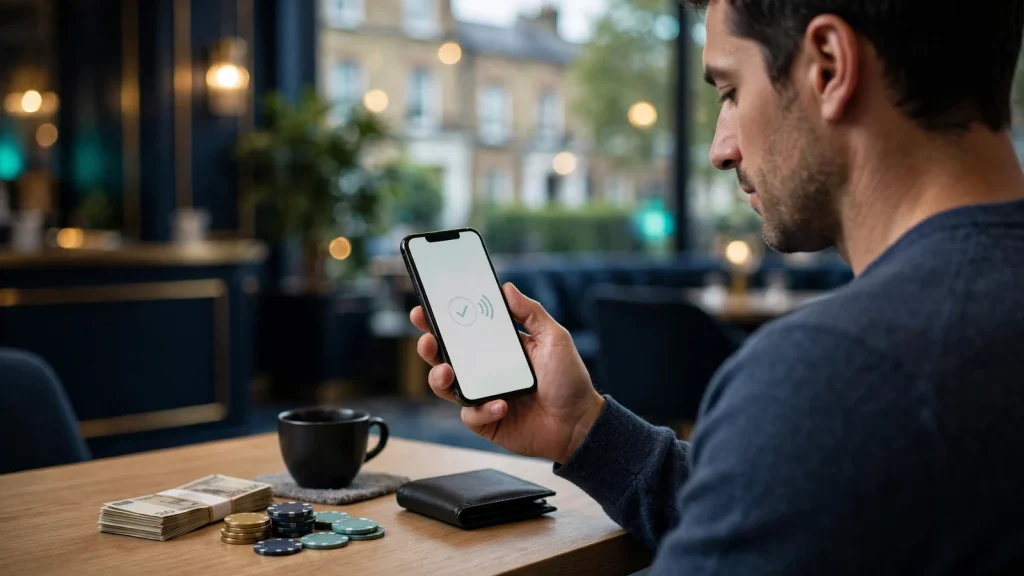
Phone-credit deposits charge a casino payment through a mobile service account rather than a bank card or digital wallet.
Table of Contents
- What Paying by Phone Credit Actually Means
- The Deposit: Amounts, Limits and the Small Print
- Playing Mobile Slots: Browser or App
- A Phone-Credit Deposit, Step by Step
- Where the Phone-Credit Charge Goes
- Online Casinos and the UK Licence
- Phone-Credit Deposits and Getting Winnings Out
- Phone-Credit Slots and the Mobile Experience
- Phone-Credit Gambling and Spending Limits
- Topping Up an Account with Phone Credit
- Casino Sites
What Paying by Phone Credit Actually Means
Paying by phone credit is a way to fund a casino account through a mobile account rather than by entering card details or using an e-wallet. It is often called Pay by Phone. The phrase can sound as though the phone itself is the payment method; more precisely, the mobile account is the route by which the deposit is charged.
That distinction matters because the money does not move in the same way as it does with a debit card or digital wallet. A card payment draws on a bank account or card balance. An e-wallet uses an account held with the wallet provider, which may itself be funded by other methods. With Pay by Phone, the deposit is associated with the mobile service account. It is not simply a card transaction made on a smaller screen.
The phone is therefore both a communication device and part of the payment chain. That does not make the transaction a purchase of airtime, nor does it mean the casino is accepting a conventional bank payment. It is a separate funding route, with its own restrictions and a markedly smaller scale. The distinction is easy to miss when all three options appear as buttons in the same cashier.
A payment route with a narrow ceiling
A specialist review of mobile casino payment methods reports that most operators set a cap of £30 for a single Pay by Phone deposit. The figure is a per-transaction ceiling, not a general statement about what every casino will accept. An individual operator can set its own terms, so the payment option and its displayed conditions matter more than the label alone.
That modest ceiling shapes what the method is for. Pay by Phone is suited to adding a limited amount to an account, not moving a substantial sum in one go. A card or e-wallet may allow a different scale of payment, subject to the operator’s rules and the payment provider’s own controls. Phone-credit deposits occupy a smaller corner of the cashier.
Casino no ID verification in the UK: what it means
The cap also helps explain why the method should not be treated as interchangeable with a bank card. A player may see familiar choices presented together, but they do not have the same capacity or relationship to the player’s finances. A bank card connects the transaction to banking infrastructure; an e-wallet places an intermediary account between the player and the casino; Pay by Phone uses a mobile account as the charging route. Similar buttons, different plumbing.
Convenience with a boundary
The appeal is partly one of separation. Someone who does not want to enter card details into a casino cashier may prefer a payment linked to their mobile account. That preference does not make Pay by Phone anonymous, nor does it remove the casino’s ordinary account checks. It changes the funding route, not the basic relationship between the customer and the operator.
There is a social history in that choice. Mobile services have long made small purchases feel as though they belong to the phone rather than to a bank account: a charge appears attached to a familiar device, at a remove from the rituals of card entry and wallet transfers. That ease is also the reason for caution. A payment can feel less like spending when it is routed through a service already used for everyday communication. The feeling is not a financial safeguard.
The fixed transaction ceiling gives the method a practical limit, but it does not decide whether a deposit is affordable. Nor does the small scale make gambling harmless. Pay by Phone is still a way of placing money into a gambling account; the fact that the charge travels through a mobile account changes the mechanics, not the stakes of the activity.
Casino Sites: Deposits, Payments and Account Options
Not every phone payment is Pay by Phone
The term can be confused with making a casino deposit on a mobile device. Those are different things. A debit-card payment made using a phone remains a card payment; an e-wallet opened on a handset remains an e-wallet payment. Pay by Phone means the mobile account itself is used as the charging route.
That difference is worth checking in the cashier, where broad labels can conceal distinct methods. The relevant question is not whether the casino is being accessed from a phone, but whether the deposit is being charged through the mobile account. Without that distinction, a search for a mobile casino that accepts phone credit can lead to payment options that merely happen to work on a mobile screen.
The method’s appeal is understandable: a familiar account, a short route into the cashier, and no need to treat a bank card as the only doorway. Its ceiling is equally clear. Pay by Phone is a limited funding channel, not a substitute for every other way of paying. A small door, by design.
The Deposit: Amounts, Limits and the Small Print
A minimum deposit is the smallest sum a casino will accept when an account is funded. It is not the same as the largest amount that can be charged in one transaction, and the distinction matters particularly with Pay by Phone. A low entry point may make a small deposit possible, while a separate transaction ceiling restricts how much can be added at once.
A specialist review reports that many casino apps set their minimum deposit at £5, with some accepting £2. These are reported examples, not a promise that every mobile casino or payment method will accept the same amount. The minimum can depend on the operator’s payment rules, and the amount shown for a card or e-wallet should not be assumed to apply to a phone-credit deposit as well. Payment options can have their own conditions.
£2 Minimum Deposit Casinos in the UK: What to Know
That difference makes the phrase “minimum deposit” less simple than it looks. It describes the lower boundary for a particular deposit route, not a universal price of entry to a casino. An app might accept a small amount through one method but set a different threshold for Pay by Phone. If the requested sum falls below that method’s minimum, the payment may not be available even though the casino accepts the amount elsewhere.
The other boundary is the transaction cap. A specialist review reports that most operators limit Pay by Phone deposits to £30 per transaction. This is a ceiling on a single charge, not an indication that every operator accepts deposits up to that amount, or that the same limit applies to every customer. The relevant figure is the one attached to the payment option in the casino account.
Taken together, the reported figures describe a narrow band: a phone-funded deposit may start at £2 or £5 at some apps, while a single transaction may be capped at £30 at many operators. The lower figure concerns what can be accepted; the upper one concerns how much can be charged in one go. Neither figure settles what a particular account will allow. The small print does.
A phone-credit deposit casino page may display several familiar amounts, but those buttons do not necessarily reveal the full rules. The minimum can be stated beside the payment method, while the maximum appears elsewhere or only after that method is selected. The amount available may also be constrained by the casino’s own account controls. A sum that looks selectable is not proof that the transaction will be authorised.
This is why a modest minimum should not be read as an invitation to keep adding small deposits. A low starting amount is a technical threshold, not a judgement about affordability. The same is true of a transaction cap: it limits one charge, but it does not itself describe how many transactions an account may make, or establish a sensible spending level. Those are separate questions, governed by separate controls.
Typical Limits
Many casino apps set a minimum deposit at £2 or £5, while a single Pay by Phone transaction is often capped at £30.
“Pay by phone credit casino no deposit” is another phrase that can blur two different ideas. A no-deposit offer, where one is available, describes an offer that does not require an initial deposit under its terms; it does not mean that a phone-credit deposit has no charge, nor does it change the payment method’s minimum or ceiling. The offer conditions determine what is required to claim or use it. A promotional label is not a substitute for those terms.
The word “no deposit” can also make the payment question sound as if it has disappeared. It has not. If an account later needs funding, the amount accepted through Pay by Phone remains subject to the operator’s conditions and the transaction limit. An offer and a deposit are different parts of the account: one concerns promotional eligibility, the other concerns money added to the balance.
For anyone comparing phone-credit deposit casinos, the useful figures are therefore not just the smallest advertised amount. The minimum needs to be checked for Pay by Phone itself, and the single-transaction maximum needs to be read alongside it. If the operator’s displayed limits differ from figures mentioned in reviews, the operator’s current payment information is the operative guide. Review figures describe a reported pattern, not a binding rule for every casino.
No ID Verification Casino Withdrawals in the UK
There is a social history tucked into these small amounts. Digital gambling often presents itself as frictionless, but payment systems preserve thresholds: a smallest acceptable sum, a maximum charge, and terms that decide which sums can pass. On a phone, those boundaries sit close to the player, inside an account screen rather than at a cashier’s desk. Convenience has paperwork in miniature.
The sensible reading is plain: a low minimum does not remove the cap, and a cap does not guarantee that the maximum can be deposited. The specific Pay by Phone limits attached to the casino account decide what is possible. Small print, indeed.
Playing Mobile Slots: Browser or App
Phone-funded play does not dictate whether a slot opens in a browser or an app. The payment choice and the way the games are displayed are separate parts of the experience. On a mobile casino, the browser is often the simplest route: most UKGC-licensed operators make instant play available through a mobile browser, without requiring a separate casino app.
Online casino with no sister sites in the UK
That matters because “mobile” is not a single piece of software. In a browser, the casino’s site loads on the phone and presents its games there. An app, by contrast, provides an installed route into the operator’s service. The distinction can affect how the interface is delivered, but the word “app” alone says little about the technology running a slot screen.
Some casino apps act as native wrappers around web content; others display games inside an embedded WebView. The latter is essentially a browser view within the app, rather than proof that every part of the game has been built to run natively. A specialist review reported that a spin button in a native wrapper responded at the instant of touch, while a WebView embed showed a noticeable half-second delay. That is a reported comparison, not a universal rule for every phone, app or game.
Small pauses can feel larger on a screen where the main action is a tap. But the route into a game does not establish what titles are available, nor does an app automatically make every game more responsive. The operator’s implementation matters. So does the particular game, and the phone on which it is being displayed. “App” is a container, not a quality guarantee.
£1 Minimum Deposit Casinos in the UK: What to Know
Browser play avoids the need to treat installation as the gateway to mobile slots. For a casino offering instant play, the site can be opened on a phone and the game launched there. That can be a useful distinction for occasional play or for anyone who prefers not to add another app to a crowded home screen. It is not a promise that every casino has the same layout or that every slot will behave identically across browsers.
Phone credit sits elsewhere in this arrangement. It may be the way funds reach a casino account, but it does not turn a browser game into an app game or change the software used to render the slot. A casino using Pay by Phone can still be assessed separately for how its mobile site works and whether its app relies on a native wrapper or an embedded WebView.
The choice is therefore less about a universal winner than about the operator’s mobile design. Browser access is widely offered by UKGC-licensed casinos; an app may provide another entrance, but its technical label is not enough to judge responsiveness. The difference is in the build.
UK casino payout rates: what RTP really means
A Phone-Credit Deposit, Step by Step
A Pay by Phone deposit begins in the casino’s cashier, not in the game itself. After signing in, the player opens the deposit area and selects the phone-payment option. The available methods depend on the casino and network; if Pay by Phone is not shown, it is not available for that account at that moment.
The next screen sets out what information is needed to continue. The steps can differ between services, so the prompts on screen matter more than assumptions carried over from another casino. Choose the requested network or payment route, then enter the deposit amount in the field provided. A specialist review describes amounts between £5 and £30 for this kind of transaction, but that is not a universal menu: the casino’s own screen determines what it will accept.
Before moving on, the amount deserves a careful look. A phone-funded payment is not simply a number typed into a box; it is a request to charge a mobile account or use its available credit. Some mobile networks add a premium-rate fee to Pay by Phone transactions. One specialist review puts that charge between £0.50 and £1.50, but the network’s terms and the payment screen should be checked rather than treating that range as a fixed tariff.
Once the amount and payment details have been entered, the service presents a confirmation step. This is the point to check the displayed total and any fee, then decide whether to proceed. If the screen does not make the cost clear, stopping there is more sensible than confirming first and investigating afterwards. The interface should identify the transaction before it is authorised; the precise wording varies by provider.
After confirmation, the casino may show a success message or an error. A successful deposit should appear in the account balance before play continues. If it does not, repeating the transaction immediately risks creating confusion about whether the first attempt went through. Check the account activity or payment status first, and use the casino’s support channel if the result remains unclear. A declined or interrupted payment is not a reason to keep submitting the same request blindly.
Phone Deposit Steps
Select Method
Open the casino cashier and choose the phone-payment option.
Enter Details
Select your network and enter the desired deposit amount.
Review Cost
Check the total amount and any applicable premium-rate fees from the network.
Confirm
Authorize the transaction and wait for the success message to see the balance update.
The sequence is short, but it contains two separate decisions: what amount to send and whether to accept the displayed charge. That distinction matters more than the number of taps. The payment page is not decorative paperwork.
This method suits a player who wants to fund an account through a mobile payment route, but it is not interchangeable with every other cashier option. The available choice can depend on the operator, the network and the account. A phone may be the device used to make the deposit without phone credit being the method; the cashier must explicitly identify Pay by Phone.
Jackpoty may receive a commission if a reader follows a link and deposits.
Where the Phone-Credit Charge Goes
A Pay by Phone deposit does not sit apart from the mobile account that made it possible. Its eventual destination depends on how that account is paid for: a contract customer sees the charge on the next mobile phone bill, while a pay-as-you-go customer has the amount taken from existing credit. The casino balance and the phone account are separate records, but the funding charge passes through the latter.
That distinction is easy to overlook because the casino transaction happens on a screen, while its cost turns up elsewhere. For a contract customer, the payment becomes part of the next bill rather than a debit from a bank card at the moment of play. For someone using pay-as-you-go, there is no later bill to collect it; the available phone credit is reduced instead. Different account arrangements, same underlying cost.
The phone is both a communications device and, in this case, a billing channel. That is a small but revealing feature of mobile casino phone credit: the transaction is attached to an account people may already use for calls, data and other services. The convenience is not that the charge disappears. It is that it travels through a familiar account rather than a separate card or e-wallet.
Non-GamStop Casinos and Instant Withdrawals Explained
This makes the mobile account part of the household’s financial picture. A contract bill may cover several kinds of service, and a pay-as-you-go balance is a finite pool of credit. In either case, a casino payment has a consequence beyond the balance shown on the casino screen. The next bill carries it, or the phone credit no longer contains it. The wording is plain; the distinction matters.
Phone-credit casino payments can therefore feel different from a purchase made with a bank card, even when the immediate action is similarly brief. The cost is associated with the mobile account, and the account’s own billing arrangement determines how it is collected. That does not make the charge less real or less worth tracking. It changes where it appears in the ordinary business of keeping accounts.
For mobile casinos using phone credit, the practical question after a payment is not where the money has gone in some abstract sense. It has been charged through the mobile service: onto the next bill for a contract account, or out of prepaid credit for a pay-as-you-go one. The casino balance records the deposit; the phone account records its cost. Two ledgers, one payment.
£3 Minimum Deposit Casinos in the UK
There is a familiar modern neatness to this arrangement: one device joins communication, entertainment and payment, while the bill preserves their separate consequences. But the phone does not turn a deposit into free credit. It merely shifts the place where the charge is collected. In a contract household, it arrives with the next bill. On pay-as-you-go, it is removed from the balance already there. No mystery.
Online Casinos and the UK Licence
A mobile casino’s payment options do not determine whether it is lawful to serve customers in Britain. An online casino may accept Pay by Phone, cards or other methods, but the central question is whether the operator holds the right UK licence. For real-money gambling offered to customers in England, Scotland and Wales, that means a licence from the UK Gambling Commission (UKGC).
Online casinos are legal in the UK when they operate under the required licence. The Gambling Act 2005 provides the main framework for gambling in England, Wales and Scotland; Northern Ireland is governed separately. The legal distinction is not merely about where a company is based. A remote operator selling gambling to people in Great Britain must be licensed for that market, even if its offices are elsewhere.
Jackpot Mobile Casinos in the UK: Prize Types
That matters when comparing a casino that offers phone-credit deposits with one that does not. A payment logo is not evidence of regulatory approval, and a polished mobile site is no substitute for a licence. The UKGC licence is the foundation for the consumer protections that apply to licensed gambling businesses. It also gives customers a route into the UK regulatory system if a dispute arises.
The footer is the starting point.
A casino’s UKGC licence number can be found at the bottom of its homepage. That number can then be checked against the UKGC register, rather than taken on trust from a badge or a statement on the casino’s own pages. The operator’s name and the licence details should correspond. A mismatch, missing number or vague claim of being “regulated” is a reason to pause before creating an account or depositing.
The distinction is especially relevant to searches for online slots or mobile casinos that take phone credit. A site may appear in search results and may even offer a familiar payment route, but neither fact establishes that it is licensed to serve British customers. Offshore casinos sit outside the UKGC system; their availability on the internet does not make them UK-licensed.
For a UK-licensed operator, age checks must take place before a customer can deposit, and online gambling is lawful for adults aged 18 and over. The licence also places the operator within a defined regulatory framework, rather than leaving the relationship entirely to the casino’s own terms. Rules have edges, and the licence marks one of them.
This page contains affiliate links. Jackpoty may receive a payment if a reader clicks a link and makes a deposit. That commercial relationship does not change the need to verify the operator’s UK licence independently.
Phone-Credit Deposits and Getting Winnings Out
A payment method can look simple at the point of entry and become less convenient at the point of exit. That distinction matters with a mobile casino pay-by-phone-credit option: a deposit puts funds into the account, but it does not, by itself, establish how winnings will be paid.
Withdrawal Terms
Casinos generally require winnings to be withdrawn using the same method used for the deposit.
Casinos almost always require a withdrawal to go back through the method used for the deposit. The rule links the money’s route in and out; it is not a promise that every payment method works equally well in both directions. Before choosing phone credit, the cashier’s withdrawal terms therefore deserve attention alongside its deposit options. The key question is whether the stated route for cashing out fits the way the account is being funded.
This can make phone credit a poor match for someone whose main concern is withdrawing winnings. A payment option may be easy to select when adding funds, while the withdrawal process follows a different set of conditions. If the casino’s terms do not make clear how a phone-credit-funded balance can be withdrawn, uncertainty remains at precisely the moment when clarity matters most. A deposit method should not be mistaken for a complete payment plan.
There is a small institutional story in that mismatch. Phone billing was built to collect money through a mobile account; casino withdrawals belong to a separate payment process. The same phone that makes the deposit possible does not automatically turn into a channel for receiving winnings. Convenience on the way in is not evidence of convenience on the way out.
For anyone comparing mobile casinos that accept phone credit, the useful distinction is between a casino that accepts this deposit route and one whose withdrawal terms suit the player’s needs. Those are not interchangeable claims. The cashier’s rules should be read before funding an account, with particular attention to whether the deposit method must also be used for withdrawal and what the operator says happens when that route cannot serve the payout.
That is less exciting than a payment button. It is also more relevant to anyone who expects to cash out.
Phone-Credit Slots and the Mobile Experience
Phone-credit slots are still slots on a small screen: the payment label does not change how a game responds once it is running. What matters in play is the path between a touch and the game’s reaction. On a phone, that brief interval can make the difference between a control feeling immediate and one seeming to hesitate.
Online Casino No Registration UK: What It Means
A specialist review reported a sharp contrast between two kinds of casino app. In a native wrapper, the spin button responded the millisecond it was touched. In a game embedded through a WebView, the reported delay was half a second. These are observations from one review, not a guarantee about every app or every phone; software, connection and device conditions can all affect what happens on screen.
The distinction is less glamorous than a new game title, but more noticeable over repeated play. A pause after a tap can make the interface feel sluggish even when the game itself is functioning. A quicker response can feel more direct, though it does not change the game’s rules or outcome. The machinery is part of the mood.
Phone-credit slots in the UK are therefore not a separate category of game experience. The phrase describes a way of funding play, while the mobile interface is shaped by how the casino has built or packaged its software. A slot may look much the same in either setting, yet the controls can feel different beneath the familiar graphics.
There is also a limit to what speed should mean. Online slot spins in Britain must last at least two and a half seconds. A button that acknowledges a touch promptly does not make the game spin faster than that rule allows; it simply registers the action without an added interface pause. Responsiveness and speed of play are not the same thing.
For anyone comparing pay-by-phone slot sites, the useful distinction is not a promise that one format is universally better. It is whether the controls feel immediate or whether each tap seems to wait for the screen to catch up. Small delay. Big presence.
Phone-Credit Gambling and Spending Limits
Paying for casino play through a mobile account can make spending feel less immediate: the amount is not handed over at a table or necessarily seen as a card transaction. That does not make it separate from gambling expenditure. A deposit still adds funds to the casino account, and the account’s own controls are the place to set a boundary.
Same-Day Payout Casinos in the UK: How They Work
UKGC-licensed operators must provide deposit limits in account settings. The available periods are daily, weekly or monthly. These are not optional flourishes tucked beside a profile picture; they are part of the protections a licensed mobile casino has to make accessible.
A limit is useful only when it is chosen before the next deposit becomes a decision made in the moment. With Pay by Phone, the payment can feel like an extension of ordinary mobile spending. The casino limit helps bring it back into view as gambling money. It is an account-level control, rather than a statement about how much a mobile network will permit on a particular transaction.
That distinction matters. The payment route and the spending boundary do different jobs. Phone credit describes how funds reach the casino account; a deposit limit governs how much can be added over the selected period. Neither should be mistaken for the other.
The quiet value of a limit is that it turns an intention into a setting. Without one, restraint depends on remembering a private promise at precisely the moment when another deposit seems appealing. With one in place, the operator’s system becomes part of that boundary. Not a cure-all. A boundary.
For anyone considering an online casino that accepts phone credit, the account settings deserve attention before play begins. The controls should be easy to find and should make clear whether the chosen limit applies daily, weekly or monthly. If the account is already being used, the same settings remain relevant: a limit is not only for a first visit, but a way to keep future deposits within a chosen frame.
Phone-funded gambling can make the act of paying feel casual. A deposit limit gives the spending a more deliberate shape. The technology may be small; the decision it contains is not.
Topping Up an Account with Phone Credit
If you’re looking for a UK mobile casino that accepts phone-credit payments, check that the payment method is currently available before you sign up. The details below confirm payout speed only, so they don’t establish whether phone-credit deposits are supported.
1. NightLuck
Payout speed: 1-3 business days The stated payout speed is 1–3 business days. No information is provided about phone-credit payments.
2. x3bet
Payout speed: 1-3 business days The stated payout speed is 1–3 business days. No information is provided about phone-credit payments.
3. Chanze
Payout speed: 1-3 business days The stated payout speed is 1–3 business days. No information is provided about phone-credit payments.
4. Amunbet
Payout speed: 1-3 business days The stated payout speed is 1–3 business days. No information is provided about phone-credit payments.
5. BeOnBet
Payout speed: 1-3 business days The stated payout speed is 1–3 business days. No information is provided about phone-credit payments.
6. SlotoSport
Payout speed: 1-3 business days The stated payout speed is 1–3 business days. No information is provided about phone-credit payments.
7. SpinFormula
Payout speed: 1-3 business days The stated payout speed is 1–3 business days. No information is provided about phone-credit payments.
8. Zombillion
Payout speed: 1-3 business days The stated payout speed is 1–3 business days. No information is provided about phone-credit payments.
9. Britsino
Payout speed: 1-3 business days The stated payout speed is 1–3 business days. No information is provided about phone-credit payments.
10. NightWin
Payout speed: 1-3 business days The stated payout speed is 1–3 business days. No information is provided about phone-credit payments.
The final amount entered matters more with Pay by Phone than with a payment method built for larger transfers. A specialist review described deposits in the £5–£30 range, while also reporting that many operators set a £30 ceiling for each phone-credit transaction. Those figures are reported observations, not a promise that every casino or network will accept the same amount.
That narrow window changes the character of a top-up. The amount is not simply a convenient round number: it must fit both the casino’s payment limit and any restriction imposed by the mobile payment route. If the amount entered exceeds the permitted ceiling, the transaction may not go through; a smaller sum may be the only workable choice. The payment screen, rather than a general description of Pay by Phone, is where the applicable amount becomes clear.
A phone-credit top-up is therefore better suited to modest funding than to moving a substantial balance into a casino account. That is the practical distinction. Choosing the amount is the last chance to pause before a small, immediate funding decision becomes part of the account balance. It should be treated as money committed to gambling, not as spare credit that can be casually replenished.
The word “top-up” can make the action sound almost administrative. It is not. A limited payment route still funds real-money play, and the amount entered deserves the same attention as any other gambling spend.
Jackpoty may receive payment if a reader clicks an affiliate link and makes a deposit.
Is it safe to use pay by phone at online casinos?
It can be used at UK-licensed casinos, which are legal and offer the strongest consumer protection in the market. Check the operator’s UKGC licence number at the bottom of its homepage; Pay by Phone changes how you deposit, not the usual account checks.
How long should a mobile casino withdrawal take in 2026?
For a UK-licensed operator, an e-wallet withdrawal should realistically take under 24 hours; the fastest observed PayPal payout took 2 hours. Bank transfers took 3–5 business days, while debit card withdrawals took 1–3 business days.
Are there any fees for using phone credit?
Some mobile networks add a premium-rate fee, usually £0.50 to £1.50, to Pay by Phone transactions.
Can I use pay by phone on pay-as-you-go?
Yes, the deposit charge can be deducted from your pay-as-you-go credit.
What does wagering on a welcome offer actually mean?
It means you must place bets totalling a specified multiple of the bonus before you can withdraw bonus winnings. Requirements are commonly 35x to 40x the bonus, usually within 7 to 14 days, and maximum bet limits, game weighting and cashout caps can also apply.
Casino Sites

£1 Minimum Deposit Casinos in the UK: What to Know
A £1 cashier minimum can get cash into an account, but bonuses, play conditions and...

£10 Minimum Deposit Casinos in the UK: Explained
Cashier limits vary by operator and payment method, while bonuses, slot stakes and withdrawals can...

£2 Minimum Deposit Casinos in the UK: What to Know
The cashier minimum applies to a deposit transaction; it does not set withdrawal limits, guarantee...

£20 Minimum Deposit Casinos in the UK: A Guide
Deposit thresholds vary by operator, so the amount required at checkout is only one part...

£3 Minimum Deposit Casinos in the UK
A low cashier minimum does not guarantee equally low withdrawals; payment rules, bonuses and mobile...

£4 Minimum Deposit Casinos in the UK: What It Means
A £4 opening deposit applies to a particular cashier route; withdrawals, other payment options and...

£5 Minimum Deposit Casinos in the UK: What to Check
A £5 cashier minimum does not guarantee bonus eligibility, and payment routes may have different...

Casino Apps in the UK: Mobile Play and Payments
The guide explains how casino apps and mobile browsers differ, from game delivery and bonus...

Instant Withdrawal Casinos in the UK: How Payouts Work
A practical look at cashier processing, payment routes, verification, bonus terms and withdrawal limits that...

Casino no ID verification in the UK: what it means
Deposits, promotions and payment options do not remove the possibility of identity checks, particularly when...

Non-GamStop Casinos and Instant Withdrawals Explained
Withdrawal timing can depend on verification, casino processing and payment routes, so “instant” does not...

Fast Withdrawal Casinos in the UK: Payout Timing
Withdrawal speed runs from confirmation of the request to funds becoming accessible, not merely a...

Jackpot Mobile Casinos in the UK: Prize Types
Jackpot labels cover different prize mechanics, while UK rules, payments and verification shape the wider...

No Account Casinos in the UK: How They Work
Assess sign-up, payment and bonus claims without mistaking fewer entry steps for fewer regulatory requirements....

No ID Verification Casino Withdrawals in the UK
A no-verification claim may mean checks are postponed until cashout, while payment methods affect settlement...

No-Minimum Deposit Casinos in the UK: What to Know
A low deposit threshold does not decide whether a payment route can be accepted for...

Online Casino No Registration UK: What It Means
Browser access can remove an installation step, but it does not establish that play is...

Online casino with no sister sites in the UK
A shared platform may signal common technology rather than ownership, while UK rules and account...

Quick Withdrawal Casinos UK: How Payouts Work
Approval, identity checks and the cashier route can all affect when winnings leave an online...

Same-Day Payout Casinos in the UK: How They Work
Payout speed depends on the payment route, processing checks and when the casino starts handling...

UK casino payout rates: what RTP really means
RTP is a long-run calculation, not a prediction for one player or session, and its...

VPN-Friendly Casinos in the UK: Access and Risks
A VPN-friendly label describes an operator’s approach to connections, not the casino’s quality, terms or...
































































































































































































































































