
Live Baccarat Online in the UK: Rules and Tables
 Available in GB
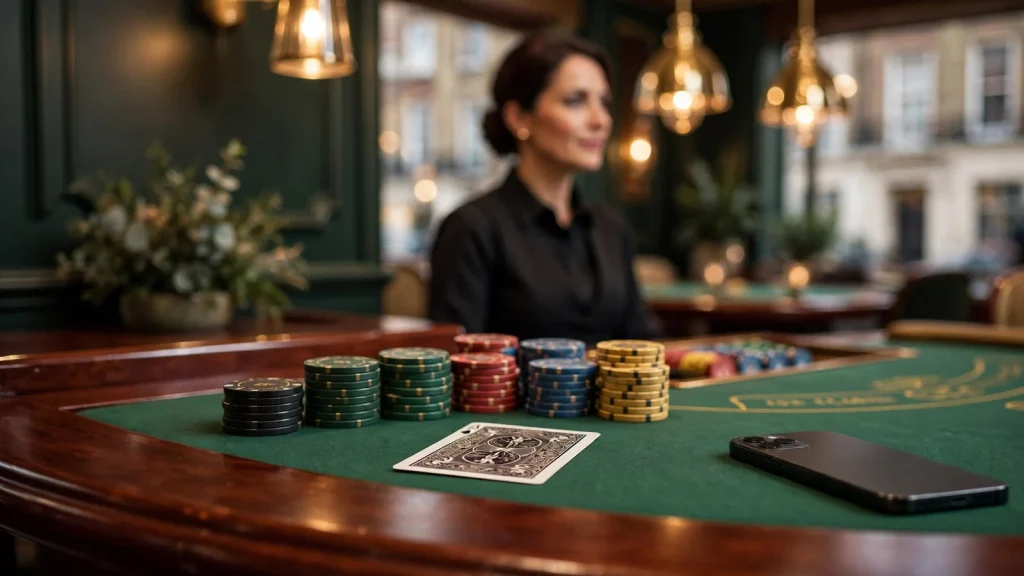
A practical look at live-table mechanics, betting costs, stream quality and the UK licensing context.
Table of Contents
- Where Baccarat Sits in the UK Live-Casino Landscape
- What Makes a Baccarat Table Worth Considering
- The Baccarat Table: Player, Banker and the Road to Nine
- Playing Baccarat Live: A Slower, More Social Ritual
- Real-Money Baccarat and the Cost of the Banker Bet
- Finding a Baccarat Table Without a Ranking
- Baccarat Among the Other Live Table Games
- Lightning Baccarat: What the Standard Rules Do—and Do Not—Tell Us
- Live Dealers, Table Pace and the Connection Behind the Stream
- Baccarat Bonuses: The Small Print Has the Larger Voice
- Jackpoty live casino
Where Baccarat Sits in the UK Live-Casino Landscape
A baccarat casino site is not simply a digital table with a familiar name above it. In its live-casino form, the game belongs to a wider online venue: a place where a studio feed brings a human dealer to the screen and betting takes place through an on-screen interface. The physical table remains elsewhere; the player’s access to it is mediated by software, a connection and the operator responsible for the service.
That distinction matters in Britain, where the word “casino” can suggest both a game and an institution. Online, a casino is an arrangement offering participation in casino games, but the appearance of a table does not settle whether the venue is operating lawfully. Remote operators serving the British market must hold the relevant licence from the UK Gambling Commission, wherever the business itself is based. A live baccarat room is therefore part of a regulated service, not a regulatory exception created by the presence of a dealer on camera.
When choosing a live baccarat casino, it helps to check the practical details available before you play. The verdicts below focus on the payout information provided for each operator.
1. NightLuck
Payout speed: 1-3 business days NightLuck lists a payout speed of 1–3 business days, a useful detail to consider when choosing a live baccarat casino.
2. x3bet
Payout speed: 1-3 business days x3bet lists a payout speed of 1–3 business days. This is the available practical detail to bear in mind for live baccarat.
3. Chanze
Payout speed: 1-3 business days Chanze lists a payout speed of 1–3 business days, giving players a stated timeframe to consider.
4. Amunbet
Payout speed: 1-3 business days Amunbet lists a payout speed of 1–3 business days. That stated timeframe is the available point of note for live baccarat players.
5. BeOnBet
Payout speed: 1-3 business days BeOnBet lists a payout speed of 1–3 business days, which may be relevant when considering how promptly you want withdrawals processed.
6. SlotoSport
Payout speed: 1-3 business days SlotoSport lists a payout speed of 1–3 business days. This is the only provided operator detail to weigh for live baccarat.
7. SpinFormula
Payout speed: 1-3 business days SpinFormula lists a payout speed of 1–3 business days, offering a stated withdrawal timeframe for players to consider.
8. Zombillion
Payout speed: 1-3 business days Zombillion lists a payout speed of 1–3 business days. The provided information gives a withdrawal timeframe but no further details about its live baccarat offering.
9. Britsino
Payout speed: 1-3 business days Britsino lists a payout speed of 1–3 business days, a practical detail to keep in mind when selecting a live baccarat casino.
10. NightWin
Payout speed: 1-3 business days NightWin lists a payout speed of 1–3 business days. No other operator details were provided to assess its live baccarat offering.
The rule expresses a distinctly British compromise. Gambling is permitted, but commercial access is made conditional on a system of licensing and oversight. The stream may look informal: a dealer speaks, cards are handled, and a table fills a screen. Behind that familiar theatre sits an operator with a legal obligation to hold the proper UK licence. The technology changes the room; it does not remove the institution.
For people looking for baccarat online in the UK, the venue is consequently more than a catalogue of games. It is the licensed operator through which the game is made available. That is the defining threshold for a legal online casino serving British players. A polished studio, a recognisable table or confident branding cannot substitute for it. Nor does an overseas address, on its own, alter the licensing requirement for an operator selling into this market.
The term “live casino” describes a format rather than a guarantee of any particular table selection. In this format, real-time studio gameplay and a human dealer are transmitted to players, who use an interface to place their bets. Baccarat can sit among those streamed offerings, alongside other casino games, but the live label refers to how the game is presented. The operator’s licence establishes the legal framework around that presentation.
This division between performance and permission is easy to overlook. A dealer visible on screen gives the game a human centre, while the betting interface makes participation look almost weightless: a few choices, a moving image, a changing balance. Regulation restores some of the institutional weight. In Britain, the operator’s status is not a decorative detail attached to the experience; it is a condition of lawful service.
French Roulette Online Casino UK: Rules and Play
The UK Gambling Commission licence is therefore the first fact that gives a baccarat venue its proper place in the national online landscape. It does not describe the atmosphere of a room or the character of a particular table. It identifies the boundary between a lawful British-facing operator and one outside the UK regulatory system. The distinction is less theatrical than the game itself. It matters more.
A live baccarat site can be understood as two things at once: a digital route into a casino game and a regulated business operating in a particular jurisdiction. The stream supplies the visible scene; the licence supplies the legal context. Neither should be mistaken for the other. Baccarat may have travelled easily from table to screen, but the operator bringing it to British players remains answerable to British rules.
That is the landscape in outline: a live format, an online venue and a licensing condition. Any discussion of the experience begins within that frame. Gambling content is for entertainment purposes only, not gambling advice; a budget set before play should remain a limit, not a suggestion.
What Makes a Baccarat Table Worth Considering
A baccarat table is not improved simply by being labelled live, nor made suitable by appearing among a large collection of games. A useful comparison starts with the conditions that shape the session: the pace of play, the minimum bet and whether the table’s presentation is clear enough to follow. These are modest criteria, but they describe the experience more honestly than a glossy claim of prestige.
Table Comparison
- Check the minimum bet against your budget
- Assess the pace of play (live vs digital)
- Review the rules and paytable
- Verify the stability of your internet connection
Live baccarat moves more slowly than its digital counterpart. Cards are dealt in real time, so the game cannot be compressed into the quick sequence possible on a screen-generated version. That slower rhythm may suit players who prefer a measured session; it may frustrate anyone expecting rapid rounds. Neither response is a verdict on the game. It is a question of temperament, though casino pages rarely treat temperament as a serious consumer category.
The minimum bet matters for the same reason. Live games have higher minimum bets than digital versions, so the amount required to take part can change the character of a session before the first hand begins. A comparison should make that entry point visible rather than hiding it beneath photographs of a velvet table. If the displayed minimum is outside a player’s planned budget, the table is not a better choice because its set looks more convincing. Set a budget before playing, and keep to it.
A table’s presentation deserves attention, too. Clear information about its rules and paytable lets a player understand the conditions before placing a wager. The display should make it possible to follow the game without mistaking decoration for useful information. A polished interface can create an impression of ease; it cannot substitute for knowing what the table offers. The distinction is ordinary, and therefore often neglected.
Connection quality is another practical consideration. Live play depends on a stable internet connection, because the game unfolds as a stream rather than as a self-contained digital round. A weak or interrupted connection can make the experience difficult to follow. This is not a question of finding the most dramatic table; it is a question of whether the stream can be watched reliably in the setting where play takes place.
Live Dream Catcher Casino UK: Format Guide
There is also a difference between a table that is attractive in a listing and one that fits a person’s habits. The description may emphasise atmosphere, but atmosphere does not alter the slower pace or the higher minimums associated with live games. A sensible comparison therefore gives greater weight to practical terms than to grand language. The casino industry has never lacked adjectives.
No single label can establish which baccarat venue is best for every player. A table can be well presented yet poorly matched to someone who wants a faster game; another can be straightforward but still unsuitable if its minimum exceeds the player’s chosen budget. The same offer may look different to someone seeking a quiet, deliberate session than to someone who values speed. Those preferences are not flaws to be corrected by a ranking.
The honest comparison is consequently a narrow one: identify the live format, understand its slower pace, note the minimum bet, check the rules and paytable, and consider whether a stable connection is available. These points do not promise a favourable result, and no presentation can make one. They help distinguish an appealing description from a table whose conditions are actually understood. Baccarat remains gambling, not a test of how carefully a page has been designed; this is entertainment, not gambling advice.
The Baccarat Table: Player, Banker and the Road to Nine
Baccarat is organised around a contest between two named hands, Player and Banker. The labels can suggest that each belongs to a person at the table, but the wager is about which hand will finish closer to nine. A Tie bet is also available. The player’s decision is therefore less a matter of building a personal hand than of choosing which side of a fixed contest to support.
Baccarat Logic
Unlike blackjack, baccarat is a forecast on which named hand—Player or Banker—will finish closer to nine, rather than a game of personal card management.
That distinction gives baccarat its unusual grammar. In blackjack, a player’s hand is measured against the dealer’s; in baccarat, the named Player hand is itself part of the game’s structure. The person placing a wager does not need to receive cards or make decisions for either hand. The central act is a forecast: Player, Banker or Tie. Simple to state; less so to reduce to instinct.
The aim is not to reach nine at any cost. It is to finish nearer to nine than the opposing hand. If a hand’s total rises above nine, only its final digit counts. A total beyond nine is thus read by its remainder, rather than treated as a bust. That small arithmetic turn changes the feel of the game: a high raw sum does not automatically mean a strong result, and the table’s target remains the same.
At the start of a hand, two cards are dealt to both Player and Banker. Their totals establish the first comparison, but they do not always settle the matter. A third card may be drawn, with that decision depending on the totals already held and the rules of the particular game. The sequence is therefore not simply “deal, compare, pay”. The opening cards can lead to another deal before the two hands are judged against nine.
This is where baccarat’s apparent simplicity acquires its mechanism. The wager is chosen before the outcome is known; the hands then develop according to their totals and the game’s rules. The person betting does not steer that development. Rather, the cards complete a procedure, and the result determines whether the chosen side finished closer to the target. The drama is procedural, not personal.
The word “Banker” can carry the air of a house advantage or a role with special authority, while “Player” sounds like an invitation to identify with a hand. At the level of the basic wager, both are names for competing outcomes. The rules decide how the hands proceed; the bettor’s choice concerns which one will be nearer to nine. The language is theatrical. The decision is spare.
For anyone encountering baccarat in an online casino, this is the foundation beneath the table display: the two named hands, the target, the Tie option and the possibility of a further card. A road to nine, then, but not a race in which every added point helps. Once a total crosses the target, its final digit is what matters. Baccarat keeps its arithmetic compact and its procedure slightly less so.
Live Casino Lightning Roulette in the UK
That is enough to understand the central wager without mistaking it for a game of personal card management. The hands are dealt, their totals are assessed, and the rules may call for another card. Player and Banker are not instructions to act; they are the sides of the comparison. The whole contest turns on proximity. A narrow idea, with room for suspense.
Playing Baccarat Live: A Slower, More Social Ritual
A live baccarat table is not merely a digital version of a game with a moving picture attached. Its centre is a human dealer, seen in a studio as the action unfolds in real time. Bets are placed through an on-screen interface, but the experience takes its shape from watching another person conduct the round. The screen becomes a small window onto a staged, shared occasion.
That distinction matters because casino games have always been social arrangements as much as calculations. A table gathers attention around a common sequence: a dealer acts, players follow, and the room—virtual or physical—waits for the outcome. Online, the room is assembled from images and timing rather than bodies. The dealer’s presence gives the sequence a visible human centre, even when everyone else remains off camera.
Baccarat has a particular aptitude for this kind of presentation. Its live form can feel immersive and recognisably casino-like without pretending that a home screen is a grand salon. The atmosphere comes from the ritual of the table: the dealer’s visible role, the shared focus on the current round, and the sense that play is happening now rather than being generated as an isolated digital event. Nothing grander needs to be claimed.
There is a small social paradox here. The players may not know one another, and their wagers pass through individual interfaces, yet the live stream gives them a common scene. It is a thin sort of company, but company nonetheless. A person watching alone can still be part of a moment organised around the same dealer and the same table. The casino has translated the crowd into a broadcast.
Crazy Time Live Casino Game Show in the UK
That translation also changes the mood. A purely digital game can feel self-contained, an exchange between a player and software. A live table introduces a human presence and a visible rhythm. The dealer is not a decorative detail: their role is what makes the stream feel like a performance of table play, rather than an animation of it. The interface remains practical, but the studio supplies the social frame.
For UK players looking to play baccarat online, that difference may be the point. The appeal is not simply having a game available on a screen; it is joining a live-dealer setting whose action is shared in real time. Baccarat casinos can therefore offer two quite different impressions under the same game name: the compact solitude of a digital interface, or the more ceremonial pace of a streamed table. Neither is inherently superior. They serve different appetites.
The live ritual does not turn online play into face-to-face company, and it does not remove the fact that wagers are being made. A calm-looking studio can soften the edges of gambling without changing its nature. Setting a budget beforehand keeps the social atmosphere from becoming a reason to extend play beyond its intended limits. The room is virtual; the money is not.
Free-play versions, where available, belong to a different category. They may allow the table’s visual style to be explored, but they do not provide real payouts or winnings. That boundary is worth keeping clear: atmosphere can be sampled without real-money play, but the two experiences are not interchangeable.
A dealer, a stream, a shared pause. That is the ritual.
Real-Money Baccarat and the Cost of the Banker Bet
Real-money baccarat brings a small piece of casino arithmetic into view: a winning Banker bet typically carries a house commission of 5%. The wager may look like a simple choice between two hands, but its price is not quite as simple as the name on the betting area suggests. When the Banker wins, the commission affects what the winning bet returns.
That charge is part of the game’s economics, not a bonus condition or a fee for using a particular payment method. It belongs in the calculation before a stake is placed. A table’s rules should make clear how its commission is applied, so the return shown on screen is not mistaken for the whole story. In real-money play, the difference between a displayed win and the amount retained matters more than the theatrical certainty of a dealer turning over the cards.
Banker Commission
A winning Banker bet typically carries a house commission of 5%, which affects the final return of the wager.
The commission also gives the Banker wager a distinctive social position. Its name sounds official, almost like a desk in a trading room; its cost is more domestic, quietly deducted from the result. The casino’s advantage is not hidden in a complicated ritual. It sits in the terms attached to the winning bet. Plainly stated, still easy to overlook.
This does not make every Banker wager a poor choice, nor does it turn another bet into a safer route. The outcome of a hand remains uncertain, and a commission is not a prediction. It is a condition of the wager. Treating it as such avoids the familiar mistake of reading a game’s labels as if they were guarantees: “Banker” names a hand, not a promise about the player’s balance.
For anyone considering baccarat for real money at a UK casino, the relevant distinction is between the game’s familiar rhythm and the cost attached to a particular result. A live table may make the process feel ceremonial: bets are placed, cards are dealt, and the room waits for the outcome. The commission is less theatrical. It is still part of that outcome, and deserves attention before the next hand begins.
The wider UK context matters too. Real-money online gambling is legal for players aged eighteen and over when the operator holds the appropriate UK Gambling Commission licence. That framework does not alter baccarat’s commission, but it defines the lawful setting in which a UK-facing casino may offer the game. Regulation is a boundary, not a way of making a wager profitable.
Deal or No Deal Casino UK: Slot Format Explained
A sensible approach is therefore unromantic: set a budget before playing, read the table rules, and include the Banker commission in any judgement about what a win means. No staking pattern removes that cost, and a run of results does not transform it into a bargain. Baccarat has always made room for ceremony. The arithmetic remains.
Finding a Baccarat Table Without a Ranking
A baccarat table is accessible only if its minimum fits the amount set aside for play. That sounds obvious, but live-casino menus can make the choice feel like a search for the right game rather than a decision about the scale of each bet. The table limit is the more useful starting point: it defines the smallest permitted wager, and therefore whether a particular table belongs within a player’s budget at all.
A specialist review reported that some live baccarat tables opened at around 20p. That is a reported figure, not a promise about every operator or a reliable guide to what will be available when a table is opened. Limits can differ between tables, and the displayed minimum is the figure that matters for the session in question. A low entry point does not establish that every betting option, format or table carries the same terms.
It is worth distinguishing the minimum from the amount a player intends to risk. A table that accepts small individual bets can still invite repeated wagering as hands unfold. A budget set before play gives that minimum a sensible context; it should not become an excuse to keep playing after the budget is gone. Table limits are boundaries, not a strategy.
Do
- Use the table limit to determine budget fit
- Check the live listing before choosing
- Keep planned spend separate from table permits
Don’t
- Use a low minimum as an excuse to exceed budget
- Rely on site-wide rankings for individual tables
- Assume all tables carry the same terms
The practical inspection is brief. The listed minimum and maximum show the permitted range; the table rules explain how its bets are settled. Both deserve attention before play begins, rather than after a wager has been placed. A familiar baccarat label does not guarantee that every table presents its options in precisely the same way. If the information is unclear, the table is not yet a considered choice.
For anyone comparing tables, accessibility is not simply a matter of finding the smallest number on screen. A lower minimum may suit a modest budget, while a higher one can make the same table irrelevant regardless of its presentation. Nor does a low minimum make a table better in any broader sense. It answers one narrow question: whether its entry point fits the intended scale of play. The rest depends on the published rules and the player’s own limits.
This is why a list of supposedly leading baccarat venues would tell little about the individual table waiting inside. A site may offer several tables with different thresholds; the relevant comparison happens at table level. The sensible approach is to check the live listing when choosing, read the rules and paytable, and keep the planned spend separate from the amount a table permits. Limits can make a game available. They cannot make it affordable after the fact.
Baccarat table choice, then, is less a hunt for a celebrated name than a small exercise in scale. The minimum is visible; the discipline required to respect it is less so. A quiet distinction.
Live Casinos in the UK: How Online Tables Work
Baccarat Among the Other Live Table Games
Baccarat belongs to a family of casino games that share a table and a dealer, but not a way of thinking. Roulette turns attention towards a wheel; blackjack makes the dealer’s hand the point of comparison. Baccarat has its own structure, rather than serving as a variation on either game. The differences are useful: they show how many kinds of decision-making can sit beneath the same live-casino roof.
In live dealer roulette, a dealer spins a physical wheel and the ball settles on a number. A winning wager depends on having selected that number. Computerised roulette replaces the wheel with a Random Number Generator, so the visible machinery changes even though the broad idea remains recognisable. One is a physical event streamed from a table; the other is generated by software. The distinction is not merely theatrical. It gives the live format a human dealer and a wheel in motion, while the computerised version has neither.
The wheel itself also carries a small lesson in how rules shape probability. European Roulette has one green pocket, marked zero. American Roulette has two: zero and double zero. The stated chance of winning in American Roulette is one in 38, compared with one in 37 in European Roulette. A single extra pocket is enough to alter the arithmetic. The wheel is an old machine, but its design remains a precise piece of house policy.
Blackjack asks for a different kind of attention. The player aims to beat the dealer by bringing a hand to 21 points without going over. Its central tension lies in the hand being built against a visible opposing hand. That makes the dealer’s position part of the immediate drama. The point is not to predict where a ball will land, but to pursue a total while avoiding an excess.
Live Roulette
Focuses on a physical wheel and ball; winning depends on selecting the correct number.
Blackjack
A contest to reach 21 points without going over, measured against the dealer’s hand.
Baccarat
A contest between the Player and Banker hands to see which finishes closer to nine.
Baccarat does not become roulette when it is dealt beside a wheel, or blackjack when a dealer is present. Its identity rests on a separate contest between the Player and Banker hands, with a Tie wager also available. Those labels can sound like descriptions of who is sitting where; they are names for the hands in the game. The distinction is easy to miss in a casino where the same interface can place unrelated tables in adjacent tiles.
This is part of the live casino’s peculiar social order. Games are grouped by format and presentation, while their underlying logic remains sharply divided. Roulette asks where the ball will stop. Blackjack asks how a hand fares against the dealer’s. Baccarat asks which of its named hands will come closer to the game’s target. Familiar surroundings, different little constitutions.
That variety matters more than any claim that one table is a substitute for another. A player drawn to the physical wheel may find roulette’s uncertainty compelling; someone interested in totals may prefer blackjack’s contest with the dealer. Baccarat offers neither of those exact experiences. It stands alongside them, not beneath them.
Lightning Baccarat: What the Standard Rules Do—and Do Not—Tell Us
“Lightning” is an arresting label, but it is not a rulebook. Standard baccarat provides a useful point of reference: its familiar wagers are on the Player hand, the Banker hand or a Tie. That is enough to describe the basic choice in the standard game, not to fill in the details of every table carrying a variant name.
The distinction matters when a casino with baccarat presents several tables under one broad heading. A name can suggest a faster, brighter or more dramatic experience; it cannot, by itself, establish what a particular game changes. The standard wagers should not be treated as proof of Lightning-specific rules, features or payouts. Those belong to the particular table’s own description and rules.
Online American Roulette in the UK: Wheel and Odds
This is a modest boundary, but a useful one. Baccarat labels often travel more freely than their details. A casino with baccarat in its lobby may group standard tables and named variants together, while the familiar game supplies the vocabulary for both. “Player”, “Banker” and “Tie” identify the standard choices; they do not explain any additional mechanic that a variant might advertise.
The same care applies when browsing an online casino with baccarat in the UK. A table title can help distinguish one offering from another, but the title is not a substitute for the rules shown with the game. A live baccarat casino site may place the variant beside standard tables, making the shared family resemblance clear while leaving the precise differences to the individual table information.
There is no need to turn that caution into suspicion. A named variant may simply be a distinct presentation of a familiar game, or it may include changes that require closer reading. The label alone settles neither point. Standard baccarat remains a sound reference for its three wagers, and a poor guide to anything beyond them.
That is the useful limit: the standard game tells what its wagers are called. It does not authorise assumptions about Lightning Baccarat. In a casino, names do their work quickly. Rules take longer.
Live Dealers, Table Pace and the Connection Behind the Stream
A live baccarat table is not simply a digital game with a decorative human figure attached. Its action comes from a studio, where a human dealer handles the game in real time; the player’s bets reach the table through an on-screen interface. The screen is therefore a working link between two places, not a moving illustration of an event happening elsewhere.
Monopoly Live Casino UK: How Online Play Works
That distinction changes the conditions of play. A stable internet connection is necessary for the stream and the betting interface to function as intended. If the connection is unreliable, the live format loses its essential quality: a continuous view of the dealer’s actions alongside the ability to participate through the screen. The studio may be real, but distance still has its small technical veto.
This is one reason a live dealer baccarat game moves more slowly than a digital version. The pace belongs partly to the physical process being shown, rather than to an animation that can move directly from one outcome to another. The dealer, cards and on-screen betting controls have to occupy the same sequence of events. Nothing especially dramatic is required; the format is built around watching an action unfold.
The slower rhythm also sits alongside higher minimum bets than those associated with digital games. That is a practical difference, not a promise of greater value or a measure of skill. The live table asks for more patience in time and, at the point of entry, may ask for more money as well. A polished studio can make this arrangement look effortless. It does not make the terms less real.
The technical chain is easy to overlook because the interface is designed to look like a table. In practice, the experience depends on a stream from the studio, a human dealer, the betting controls and a reliable connection carrying the exchange. The screen makes those separate elements appear to belong to one room. They do not.
For an online live dealer baccarat casino, then, the stream is not an accessory to the game. It is the means by which the game reaches its remote participants. The slower pace is part of that arrangement; so is the need for a connection steady enough to sustain it. A table on screen is still a table at a distance.
Baccarat Bonuses: The Small Print Has the Larger Voice
A baccarat welcome offer can look generous in its headline and become modest in practice. The relevant question is not simply how much a casino advertises, but whether live baccarat is eligible and how much each wager counts towards any wagering requirement.
A specialist review reports that UK welcome offers commonly centre on free spins for slot games, which cannot be used at live tables. That observation describes the offers it examined, not a permanent rule for every operator. A baccarat casino bonus may therefore be absent from a welcome package altogether, even where the casino has a live baccarat lobby.
When baccarat is eligible, its contribution may still be below the full value of a wager. A specialist review notes that some baccarat promotions apply reduced game weighting; live games can account for only a small share of wagering, with 10% given as an example. The practical effect is that progress towards a requirement may be slower than the headline sum suggests. The terms, not the banner, decide.
The same scrutiny applies to a baccarat deposit bonus or a no-deposit offer. The label does not establish that live baccarat qualifies, nor does it explain whether the bonus balance, winnings, or both are subject to conditions. Eligibility, game weighting, wagering requirements and maximum bet limits belong in the terms before opting in. A no-deposit label is not a promise of unrestricted play.
Searches for a baccarat casino bonus in the UK can also lead to offers framed around other games. The word “casino” on a promotion does not mean every table contributes equally. For a Bitcoin baccarat casino, payment method and bonus eligibility are separate questions; neither should be inferred from the other.
Promotions are written to be noticed quickly. Their conditions are written to govern what happens afterwards. Set a budget before playing, and do not treat bonus credit as a reason to extend it. This is entertainment, not gambling advice.
How do you choose a live dealer casino?
Choose a UK Gambling Commission-licensed operator, then check the table’s minimum bet, rules and paytable, pace, and whether your internet connection is stable enough for live play. Set a budget before playing and keep to it.
Why does the dealer always win in blackjack?
The dealer does not always win: players can beat the dealer by finishing closer to 21 without going over. Blackjack still has a house edge, so the casino retains an advantage over time.
What is the difference between European and American Roulette?
European Roulette has one green pocket, 0; American Roulette has two, 0 and 00. The odds of winning are 1 in 37 on European Roulette and 1 in 38 on American Roulette.
Jackpoty live casino

Live Casinos in the UK: How Online Tables Work
Live casino games broadcast dealers and table play through an online interface, but the format...

Crazy Time Live Casino Game Show in the UK
A look at the studio-and-interface format, UK casino context and the limits of claims about...

Deal or No Deal Casino UK: Slot Format Explained
The guide distinguishes the familiar Banker-and-briefcase premise from slot features, bonus searches and what free...

French Roulette Online Casino UK: Rules and Play
French roulette combines a single zero with La Partage on eligible even-money bets, alongside live...

Live Blackjack Online Casinos in the UK: How It Works
A live dealer runs the physical game in a studio while players follow the stream...

Live Casino Lightning Roulette in the UK
A live stream connects a physical dealer and wheel to digital betting controls, while computerised...

Live Dream Catcher Casino UK: Format Guide
The guide separates the studio broadcast from software-led play and sets out practical points for...

Live Roulette in the UK with English-Speaking Dealers
A look at the live studio setup, betting interface, wheel formats and the limits of...

Monopoly Live Casino UK: How Online Play Works
The format pairs a real studio and dealer with screen-based wagers, while rules and availability...
Online American Roulette in the UK: Wheel and Odds
The double-zero pocket distinguishes American roulette and shapes how its live tables, bets and payouts...

European Roulette at UK Online Casinos: Rules and Play
A guide to European roulette’s single-zero wheel, betting options and the differences between online spins...
































































































































































































































































