
French Roulette Online Casino UK: Rules and Play
 Available in GB
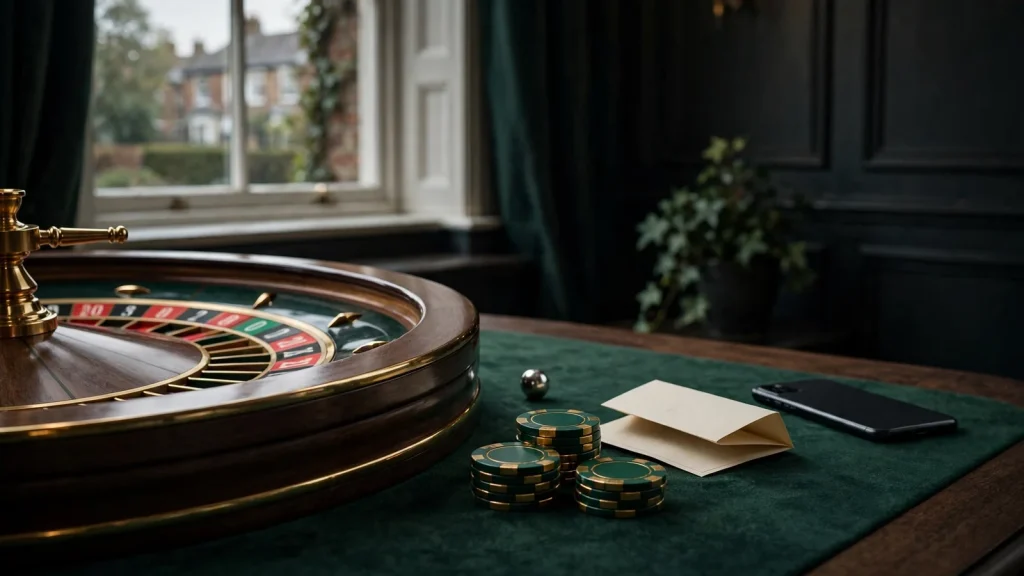
French roulette combines a single zero with La Partage on eligible even-money bets, alongside live and RNG table options.
Table of Contents
- French Roulette’s Zero and the Half-Stake Return
- What Makes a French Roulette Table a Better Fit
- The Live Wheel: Dealers, Ball Drops and Pace
- Low Stakes, Standard Tables and the Cost of Pace
- RNG French Roulette and the Faster Online Spin
- UK Casinos, Licensing and the Rules Around Play
- Premium Tables and Bonus Terms: Read the Small Print
- Roulette Bets: Numbers, Neighbours and Outside Choices
- Playing Online Without Mistaking a System for an Edge
- When the Casino Wheel Is Not French Roulette
- Jackpoty live casino
French Roulette’s Zero and the Half-Stake Return
The defining feature of French roulette is not its language or its setting, but what happens when the ball finds zero. The wheel has one green zero alongside the numbered pockets, as in European roulette. On a table using La Partage, however, zero does not treat every wager in the same way. For an even-money bet, half the stake is returned rather than the whole stake being lost.
That small change alters the character of the game. A bet on red or black, for instance, still loses when zero appears, but only half of its stake is forfeited under La Partage. The remaining half comes back. The rule does not make a winning outcome more likely, nor does it remove the zero from the wheel. It changes the cost of one particular losing result.
This is the point at which a rule about a ball becomes a rule about the terms of play. In roulette, a zero gives the house an outcome that falls outside the familiar red-or-black, odd-or-even choices. La Partage softens that interruption for even-money wagers. It is a narrow concession, not a general refund on every type of bet: wagers on individual numbers and other bet types do not gain the same treatment simply because the table is French.
If you’re looking for French roulette at an online casino in the UK, this list offers a starting point for considering the operators. Payout speed is one practical detail to keep in mind when reviewing your options.
1. NightLuck
Payout speed: 1-3 business days NightLuck lists a payout speed of 1–3 business days, a useful detail to consider when assessing how quickly you may receive a withdrawal.
2. x3bet
Payout speed: 1-3 business days x3bet lists a payout speed of 1–3 business days. This gives you a stated timeframe to consider when looking at withdrawals.
3. Chanze
Payout speed: 1-3 business days Chanze lists a payout speed of 1–3 business days, providing a specific withdrawal-timing detail for your review.
4. Amunbet
Payout speed: 1-3 business days Amunbet lists a payout speed of 1–3 business days. Consider this stated timeframe as part of your review.
5. BeOnBet
Payout speed: 1-3 business days BeOnBet lists a payout speed of 1–3 business days, giving readers a clear detail about withdrawal timing.
6. SlotoSport
Payout speed: 1-3 business days SlotoSport lists a payout speed of 1–3 business days. This is the available detail on its payout timing.
7. SpinFormula
Payout speed: 1-3 business days SpinFormula lists a payout speed of 1–3 business days, a practical point to note when considering withdrawals.
8. Zombillion
Payout speed: 1-3 business days Zombillion lists a payout speed of 1–3 business days. This stated timeframe can help inform your review.
9. Britsino
Payout speed: 1-3 business days Britsino lists a payout speed of 1–3 business days, offering a specific detail about its withdrawal timing.
10. NightWin
Payout speed: 1-3 business days NightWin lists a payout speed of 1–3 business days. This is the available factual detail about the operator.
The arithmetic is unusually clear. European roulette has thirty-seven pockets: the numbers from one to thirty-six and a single zero. With no special rule, that green pocket gives the house its mathematical advantage. Under La Partage, the house edge on even-money bets falls to 1.35%. That figure describes the long-run mathematical cost of those bets, not a prediction of what will happen in any particular session. In a single spin, the ball remains indifferent to the elegance of the rule.
The distinction matters because “French roulette” can describe a set of rules, not just the appearance of a digital table. An online game may display a French name or a familiar single-zero layout while applying different rules to zero. The relevant detail is the table’s stated treatment of even-money bets. If La Partage is not included in the rules, its benefit cannot be assumed from the label alone.
French roulette is also associated with En Prison, another rule affecting even-money bets when zero appears. Alongside La Partage, it helps give the French variant the lowest house edge among standard roulette variants. The two rules should not be confused: La Partage returns half the stake immediately, while En Prison is a separate provision. The exact conditions for En Prison are a matter of the individual table’s rules, so its presence should be confirmed rather than inferred.
Live Baccarat Online in the UK: Rules and Tables
There is a social history in that preference for a partial return. Roulette’s zero is not a neutral detail; it marks the boundary between the player’s familiar choices and the house’s advantage. La Partage makes that boundary less severe for a limited class of wagers. It does not abolish the house advantage, and it does not promise a kinder run of results. It simply gives the zero a less costly consequence when the bet is even-money.
That is why the rule attracts attention among people looking for French roulette online. The appeal is mathematical, not mystical: the wheel keeps its single zero, but the settlement rule changes what happens to certain stakes when it appears. Anyone comparing French roulette casinos is therefore comparing more than graphics, language or table names. The rule attached to zero is part of the game itself.
It is tempting to hear “half returned” as a generous gesture. In practice, it is a precise condition with a precise scope. The ball must land on zero, the wager must qualify as even-money, and the table must offer La Partage. Outside those conditions, the rule has nothing to say. A player who places a different kind of wager does not receive half back merely because the game is French roulette.
The lower edge is meaningful, but it is not an escape from chance. Each spin produces one result, and the rule governs how a qualifying wager is settled after that result. It cannot turn a losing outcome into a win; it reduces the loss when zero intervenes. In that respect, French roulette is a game whose customs are unusually visible: a single pocket, a partial return, and a house advantage narrowed by a rule rather than erased.
The zero remains. The terms change.
La Partage
Under this rule, half the stake is returned to the player for even-money bets when the ball lands on zero, rather than the entire stake being lost.
What Makes a French Roulette Table a Better Fit
A French roulette table is a better fit for players who care about the mathematical cost of a wager, not because it changes chance into a skill. The useful comparison begins with the wheel and the rules attached to it. European roulette has a house edge of 2.70%; American roulette has an edge of 5.26%. The difference is built into the games, not into the dealer’s manner, the graphics or the confidence of the table’s name.
That distinction gives a more reliable way to assess an online French roulette casino in the UK than a ranking based on presentation. A polished lobby can make a game easier to find, but it does not alter the odds. The table’s rules determine how a result is treated, while the wheel determines the pockets in play. A French table’s lower cost on qualifying even-money bets comes from its rules; it should not be confused with a universal reduction on every kind of wager.
House edge is a long-run measure of the casino’s mathematical advantage. It is not a forecast of what happens in a particular session. A player may win or lose over a short spell, and the lower edge does not promise a return. It describes the expected cost of repeated play under the game’s rules. That makes it useful for comparing variants, but a poor instrument for predicting the next spin.
The European figure offers a baseline: one single-zero format carries a 2.70% house edge. Against it, the American figure of 5.26% makes the cost of the alternative plain. The gap is not a matter of atmosphere. It is a structural difference in the game’s mathematics, and it persists whether the table is presented online with elaborate animation or a restrained layout.
Crazy Time Live Casino Game Show in the UK
The phrase “best French roulette casino” can suggest that one operator has somehow improved the wheel. That is too generous to the lobby. A sound comparison asks whether the available table is actually French roulette, what rules apply to the relevant bets, and whether the stated game information is clear enough to check. A French label alone is not a mathematical explanation. If the table description is vague, its name cannot do the work of its rules.
This is also why casino choice should not be reduced to a single headline edge. The overall figure gives a useful comparison, but particular bets can be treated differently under French rules. A lower edge on eligible wagers does not mean every stake carries the same cost. The practical question is therefore not simply which table has the most appealing title, but whether its rules match the kind of play being considered.
For someone comparing French roulette casinos, consistency matters more than a claim of superiority. The game should be identified clearly, the relevant rules should be visible, and the displayed information should make it possible to distinguish a French table from a European or American one. These checks do not make the result predictable. They do prevent a player from comparing unlike games as if the labels were interchangeable.
The house edge also puts marketing language in proportion. “Better” can mean a lower mathematical cost, but it cannot mean a guaranteed advantage over the casino or a better chance of winning a particular round. A table may look more inviting, and the interface may make decisions easier to follow; neither changes the underlying calculation. The number is less glamorous than the graphics. It is also more useful.
French Roulette
Features the lowest house edge on qualifying even-money bets due to rules like La Partage.
European Roulette
Utilizes a single-zero wheel with a standard house edge of 2.70%.
American Roulette
Contains both a single and double zero, resulting in a higher house edge of 5.26%.
For a player seeking the best online French roulette casino, then, the relevant standard is not a league table of brands. It is a clear French ruleset and a lower-cost structure than the American alternative, understood without confusing long-run expectation with short-term fortune. European roulette’s edge is 2.70%, compared with 5.26% for American roulette. That comparison gives the choice its substance. The rest is decoration.
The Live Wheel: Dealers, Ball Drops and Pace
A live French roulette table is not an animation dressed up as a casino. The game comes from a studio, where a human dealer sets a physical wheel in motion and releases a real ball. A camera carries the wheel, the dealer’s hands and the ball’s changing path to the screen. The result is a game whose central event is visible rather than generated behind an interface.
That visibility changes the texture of a round. There is a small sequence to follow: the dealer prepares the wheel, the ball circles, loses speed and drops into a pocket. The table then moves on. The camera may show the wheel closely or keep the dealer and betting layout in view, but the attraction is the same: a physical object behaves in a way that cannot be hurried by clicking a button.
The dealer is part of the presentation, not a fortune-teller. Their gestures mark the stages of play and help make a stream feel like a shared table rather than a succession of isolated results. There is room for the ordinary pauses of a broadcast: the wheel turning, the ball rattling, the table resetting. It is a modest theatre, and the machinery is allowed to show.
Deal or No Deal Casino UK: Slot Format Explained
That pace can be quite different from faster roulette formats. A specialist review reports speed roulette at more than 150 spins per hour, against 80–100 spins per hour at a standard table. These figures describe formats, not a promise about every live French roulette stream: the dealer, studio and table design all shape how quickly a particular game moves. Still, the broad distinction is easy to see. A conventional live table leaves more time around the event; speed roulette compresses the interval between one result and the next.
The difference is not merely a matter of waiting. A slower stream gives the round a beginning and an end that are easy to notice. The dealer’s movements, the ball’s drop and the pause before play resumes make each result feel discrete. In a quicker format, those transitions are shortened, and the eye is asked to follow a more continuous cycle. Neither presentation changes the nature of roulette; one simply gives its ritual more space.
For a live French roulette casino experience, the practical detail is therefore the table’s rhythm, not just the word “live” on its label. A physical wheel and a human dealer identify the format, but they do not guarantee a leisurely session. Some tables are designed to move briskly, while others retain more of the studio-table cadence. The stream itself reveals the distinction: how long the dealer leaves between rounds, how the betting phase is framed, and how much of the wheel’s action remains on screen.
Do
- Consider the table’s rhythm and pace
- Observe the dealer’s movements and pauses
- Check the frequency of rounds per hour
Don’t
- Assume all “live” tables move at the same speed
- Confuse a physical wheel with a fast-paced format
- Ignore the difference between standard and speed roulette
The appeal of live casino French roulette rests partly on that visible process. The wheel is old-fashioned in the most literal sense: it turns in a room, under a camera, while an audience watches from elsewhere. The online setting removes the shared physical table but preserves its ceremony. A ball still has to travel. A dealer still has to release it. The screen becomes a window onto a small, carefully repeated performance.
For some, that is the point; for others, the pauses are simply part of the cost of a live presentation. Speed roulette trims them. The standard live table lets them breathe. A matter of tempo.
Low Stakes, Standard Tables and the Cost of Pace
A low minimum stake can make roulette look gentler than it is. The figure on the table describes the smallest permitted wager, not how long a session will last or how many decisions will pass through it. With roulette, pace matters: more rounds create more occasions to stake, even when each individual bet is small.
A specialist review of UK tables reports live roulette minimums starting at 10p, while auto-roulette and speed formats sometimes begin at 5p. These are entry points, not promises that every table will offer those limits. They also do not tell the whole story of a session. A table with a low minimum may still move quickly; a higher limit may sit within a slower format. The stake and the rhythm are separate parts of the cost.
That distinction is easy to lose in the language of “low limits”. A small opening wager can sound like a complete measure of affordability, although it only sets the floor for one bet. A player may choose to stake more, repeat bets rapidly, or continue for longer than intended. The minimum is useful information, but it is not a budget and cannot stand in for one.
Monopoly Live Casino UK: How Online Play Works
How formats change the rhythm
At a live table, the physical wheel and dealer give each round a visible sequence: bets close, the ball is released, the result is called, and the next betting period begins. Auto-roulette retains the roulette table but automates its operation. Speed roulette is designed to move rounds along more briskly. The presentation changes, and so can the number of decisions packed into a session.
A specialist review places speed roulette at more than 150 spins per hour, compared with 80–100 at a standard table. Such rates should be treated as descriptions of formats, not as a clock guaranteed to every game. Still, the contrast captures a practical point: when rounds arrive more quickly, the same stretch of time can contain many more opportunities to wager. A 5p minimum does not slow those opportunities down.
The gentler appearance of a tiny stake can therefore sit beside a demanding pace. At a fast table, the next round may arrive before the previous result has had much time to register. The interface can make this flow feel effortless; the arithmetic of repeated wagers remains less picturesque. Small sums accumulate through repetition.
Choosing a limit, not a label
“Standard” is not a universal stake band. Table limits belong to individual games and operators, and a format name alone does not settle what a table will accept. A low-limit table may be listed among several versions of the same roulette game, while tables with larger minimums serve players seeking a different scale of play. The useful comparison is concrete: the displayed minimum, the maximum permitted stake, and the pace at which rounds proceed.
Attention A low minimum stake does not guarantee affordability, as high game pace can lead to a rapid accumulation of repeated wagers.
High-limit play changes the scale of the wager, not the underlying nature of roulette. A table with a larger minimum is not automatically faster, more skilful or more rewarding. Likewise, a low-limit table does not become harmless simply because its entry point is modest. The pace can make restraint harder to maintain, especially when the screen presents one round after another with little interruption.
For anyone comparing French roulette tables, the practical distinction is between the amount required to join and the rate at which the game invites another decision. A 5p entry point may be available in auto-roulette or speed formats; a live table may start at 10p. Those starting figures describe access. The tempo describes how quickly that access can turn into repeated play.
Small stakes. Quick consequences.
RNG French Roulette and the Faster Online Spin
A digital roulette table has no ball to watch and no dealer waiting for bets to close. In an RNG version, a random number generator supplies the simulated result, and the game presents that result as a spin of the wheel. The interface may resemble a familiar casino table, but the event itself is produced by software rather than by a ball travelling around a physical rim.
That difference changes the rhythm. A live table has human pauses: the dealer calls the end of betting, releases the ball, waits for it to settle and records the outcome. An RNG game can move directly from one completed result to the next. There is no studio feed to follow and no physical wheel in view. The screen is less a window onto a room than a quick display of the game’s current state.
Live Dream Catcher Casino UK: Format Guide
The speed is measurable, though not identical across formats. Figures for RNG American roulette put play at 150 to 200 spins an hour, sometimes exceeding that range. Live dealer play is described at a much slower 50 to 60 rounds in the same period. Those figures concern American roulette, so they should not be treated as a precise clock for every French roulette game. They do show the scale of the difference between software-led rounds and a streamed physical table.
A faster cycle can make online French roulette feel more continuous. A result appears, the betting layout resets, and another round is ready without the ceremonial interval that gives a live game its sense of occasion. That can suit someone who wants to concentrate on the sequence of decisions rather than on the dealer’s handling of the wheel. It can also make time harder to notice: when little separates one round from the next, the game offers fewer natural pauses.
The RNG format does not turn roulette into a prediction exercise. Each simulated spin remains a chance outcome; a previous result does not provide a dependable clue to the next one. The software changes how the wheel is represented and how quickly the game can proceed, not the basic uncertainty that makes roulette roulette. A digital wheel may look familiar. It does not remember.
There is also a difference in what the screen asks for attention. In a live French roulette game, the dealer, wheel and ball are part of the experience; the result arrives through a visible physical sequence. In an RNG version, animation may imitate that sequence, but it is a presentation of a generated result. The distinction matters less as a question of spectacle than of expectation: a player choosing a simulated table is choosing the briskness of software, not a remote seat in a studio.
RNG vs Live Dealer Pace
Software-led RNG games can reach 150 to 200 spins per hour, whereas live dealer play typically moves at a slower pace of 50 to 60 rounds in the same period.
That briskness is not automatically an advantage. More rounds can fit into the same stretch of time, so a session may gather momentum before its duration is obvious. The contrast with live play is therefore not simply “digital versus real”; both are online games, but one shows a physical wheel through a stream while the other simulates spins. The pace belongs to the format, and it shapes the texture of play as much as the graphics do.
For an online French roulette casino, the useful distinction is not whether the screen reproduces a green baize table convincingly. It is whether the game offers a simulated spin or a streamed wheel, and whether its pace fits the kind of attention the session can sustain. One is theatre at a distance; the other is a succession of software-generated outcomes.
Less ceremony. More rounds.
UK Casinos, Licensing and the Rules Around Play
A casino table shown on a screen belongs to a wider system of permissions and duties. In Great Britain, the UK Gambling Commission (UKGC) regulates online casino activity and is the sole regulator. A business offering real-money live roulette to British residents must hold a valid UKGC operating licence, wherever that business is based. A platform without one cannot legally provide that service to people in Britain.
That distinction matters when a game is presented as French roulette. The wheel’s label does not establish who operates the site or under which rules. A current licence can be checked on the UKGC public register before money is deposited. Offshore casinos may be accessible, but accessibility is not the same as permission to serve the British market.
Permission comes with duties.
Live Blackjack Online Casinos in the UK: How It Works
Age checks are part of the entry to gambling, not an afterthought: operators must verify a customer’s age before allowing a deposit into a gambling account. Online gambling in the UK is legal for adults aged 18 and over when it takes place through an operator holding the relevant UKGC licence.
Financial controls are also built into the licensed relationship. Before a new customer makes a first deposit, the operator must prompt them to set a financial limit, and account-level limit controls must remain accessible. UKGC-licensed live casino operators must offer deposit and loss limits, alongside session time reminders and reality checks. These tools put a boundary around play that can otherwise continue inside a screen with little sense of elapsed time.
A cool-off period offers a temporary break; GamStop provides self-exclusion across participating gambling businesses. Self-exclusion is not simply a setting for one roulette table, but a wider restriction on access to gambling accounts. The difference is important: one tool interrupts a session, while the other addresses access at a broader level.
Licensed operators must also provide an internal complaints process and access to an approved Alternative Dispute Resolution service. They are required to contribute to the Research, Education and Treatment levy. These obligations rarely appear in the presentation of a game, yet they are part of what makes a regulated casino more than a stream and a payment screen.
Payment rules form another boundary. UKGC-licensed casinos cannot accept credit cards for gambling, including credit-card funds routed through a money service business. Nor can operators accept wallet payments where the wallet allows credit-card funds to be used for gambling. The restriction follows the funding route, not merely the button displayed at checkout.
Licensing
A business offering real-money live roulette to British residents must hold a valid UKGC operating licence to be legal.
These safeguards do not make roulette predictable or remove the possibility of loss. Their purpose is narrower and more practical: to set conditions for who may gamble, how operators must handle accounts, and what support and limits must be available. The regulated market is defined as much by those obligations as by the games it sells.
Premium Tables and Bonus Terms: Read the Small Print
A premium French roulette table can ask for larger stakes without making its bonus terms more generous. Table limits and game weighting are separate decisions: the first determines how much a spin costs, while the second determines how much a roulette wager counts towards a bonus wagering requirement.
Across UK operators, roulette wagers are commonly counted at 10% to 20% of those requirements. That means a wager may make only a limited contribution to clearing bonus funds, even when the table itself has a high minimum. The label “premium” describes neither the contribution rate nor the value of a promotion.
Rates vary by operator and game. One specialist review describes live roulette as counting at 10% or 20% in some terms, while RNG roulette may count at 100%. These are not universal settings: an operator’s own bonus rules determine what applies, and live roulette may be excluded altogether from a particular offer. The table description cannot settle the question.
A specialist review also reports that, since January 2026, UK regulations cap bonus wagering requirements at a maximum of 10x for licensed operators. That cap limits the stated requirement; it does not make every bonus equally attainable or change how much roulette contributes. A low contribution rate can still mean that roulette wagers do little to complete the requirement.
This distinction matters particularly around premium play, where a larger stake can create the impression that more progress is being made. The arithmetic may say otherwise. If only a fraction of a wager counts, increasing the stake does not alter the operator’s weighting rule; it simply increases the amount committed to the game.
The relevant terms are usually found in the promotion’s wagering section, where the game weighting and any exclusions should be stated. Bonus funds and cash balances may also be treated differently under those conditions. The useful comparison is therefore not between grandly named tables, but between the table’s limits and the specific bonus terms attached to play.
A premium table can be costly. Its contribution may remain modest.
Roulette Bets: Numbers, Neighbours and Outside Choices
A French roulette layout groups wagers by where they sit on the table and how many numbers they cover. A single-number wager is the most concentrated choice: a straight-up bet on one number pays 35:1. The same payout applies on European and American roulette. The figure describes the return attached to that winning bet, not a prediction that the number is more likely to appear.
A split bet covers two adjacent numbers, with the chip placed across the line between them. Its payout is 17:1. That modest change in coverage comes with a different quoted return: the wager now names a pair rather than a solitary pocket. Online, the layout serves as both menu and map; the position of a chip indicates which numbers are included. Small visual distinctions, substantial consequences.
Straight-up Bet
Example: 35:1 × £1 = £36 (including original stake).
Outside bets sit beyond the numbered grid and cover broad groups rather than individual pockets. Red or black, even or odd, and high or low each pay 1:1. Their appeal is legibility: the choice concerns a colour, a parity group or one side of the number range, rather than a specific point on the layout. The return is correspondingly expressed at even money.
These payouts give the French roulette casino game its basic vocabulary. A player can choose narrow coverage with a larger stated payout, or a broad category with a smaller one. Neither description changes what the wager is: a selection on the table, settled when the ball’s result is known. A higher payout is not a measure of skill, nor does a familiar outside option make its result certain.
The same distinctions are visible in an online French roulette casino game, where the betting grid replaces felt but retains the numbered and outside areas. The interface may make selection quicker; it does not alter the quoted payout for these bet types. Keeping the terms separate helps: the bet defines what must happen for a win, while the payout states what that winning selection returns. Simple enough.
Playing Online Without Mistaking a System for an Edge
A betting system can make uncertainty look orderly. The Martingale is the cleanest example: after each loss, the stake is doubled, with the hope that a later win will recover what was lost and leave a small gain. On paper, the sequence seems to have a destination. In practice, the next result is no more knowable because the previous one went badly.
That distinction matters when playing French roulette online. A staking pattern changes the size of the bets, not the chances governing the outcome. No sequence can make a future result predictable; chance does not keep a ledger of earlier losses and arrange to settle it.
The Martingale also asks a bankroll to withstand a succession of larger commitments. Each loss raises the next stake, so a losing streak can consume funds quickly and leave little room to continue. The system’s apparent neatness depends on being able to keep doubling, while real budgets and table limits do not expand to accommodate a theory.
Live Roulette in the UK with English-Speaking Dealers
There is a social comfort in systems: they offer a ritual where control is otherwise absent. That comfort can be costly when it encourages larger stakes precisely as losses accumulate. A fixed budget and a decision to stop are less theatrical, but they do not pretend to alter the odds.
The useful question is not whether a system can guarantee recovery; it cannot. It is whether the planned stakes remain affordable if the sequence goes against expectation. The wheel owes no one a correction.
When the Casino Wheel Is Not French Roulette
A table labelled simply “roulette” does not necessarily offer the French game. American roulette changes the wheel itself: alongside numbers 1 to 36, it has a zero and a double zero, making 38 pockets. That extra green pocket matters because it changes the odds attached to wagers, not merely the appearance of the layout.
The distinction is especially stark on the American basket bet, which covers 0, 00, 1, 2 and 3. Its house edge is 7.89%, higher than the 5.26% edge for American roulette overall. The bet may look like a compact way to cover several outcomes, but its price is unusually steep. A neat patch of felt can conceal an expensive wager.
Some specialist reviews describe American online tables with a third green pocket marked 000. On those tables, the reported house edge is 7.69%. That figure belongs to the particular three-zero format described, not to American roulette as a whole; the wheel’s pocket count should therefore be checked rather than inferred from a short game label.
French roulette is a different proposition, and its single-zero wheel is part of that distinction. A double-zero American layout should not be mistaken for it simply because both games use familiar numbered pockets and green zero spaces. The name on a tile can be brief; the wheel is less ambiguous. Where a third zero appears, the difference is plainer still.
Jackpoty live casino

Live Casinos in the UK: How Online Tables Work
Live casino games broadcast dealers and table play through an online interface, but the format...

Crazy Time Live Casino Game Show in the UK
A look at the studio-and-interface format, UK casino context and the limits of claims about...

Deal or No Deal Casino UK: Slot Format Explained
The guide distinguishes the familiar Banker-and-briefcase premise from slot features, bonus searches and what free...
Live Baccarat Online in the UK: Rules and Tables
A practical look at live-table mechanics, betting costs, stream quality and the UK licensing context....

Live Blackjack Online Casinos in the UK: How It Works
A live dealer runs the physical game in a studio while players follow the stream...

Live Casino Lightning Roulette in the UK
A live stream connects a physical dealer and wheel to digital betting controls, while computerised...

Live Dream Catcher Casino UK: Format Guide
The guide separates the studio broadcast from software-led play and sets out practical points for...

Live Roulette in the UK with English-Speaking Dealers
A look at the live studio setup, betting interface, wheel formats and the limits of...

Monopoly Live Casino UK: How Online Play Works
The format pairs a real studio and dealer with screen-based wagers, while rules and availability...
Online American Roulette in the UK: Wheel and Odds
The double-zero pocket distinguishes American roulette and shapes how its live tables, bets and payouts...
European Roulette at UK Online Casinos: Rules and Play
A guide to European roulette’s single-zero wheel, betting options and the differences between online spins...
































































































































































































































































