
Live Dream Catcher Casino UK: Format Guide
 Available in GB
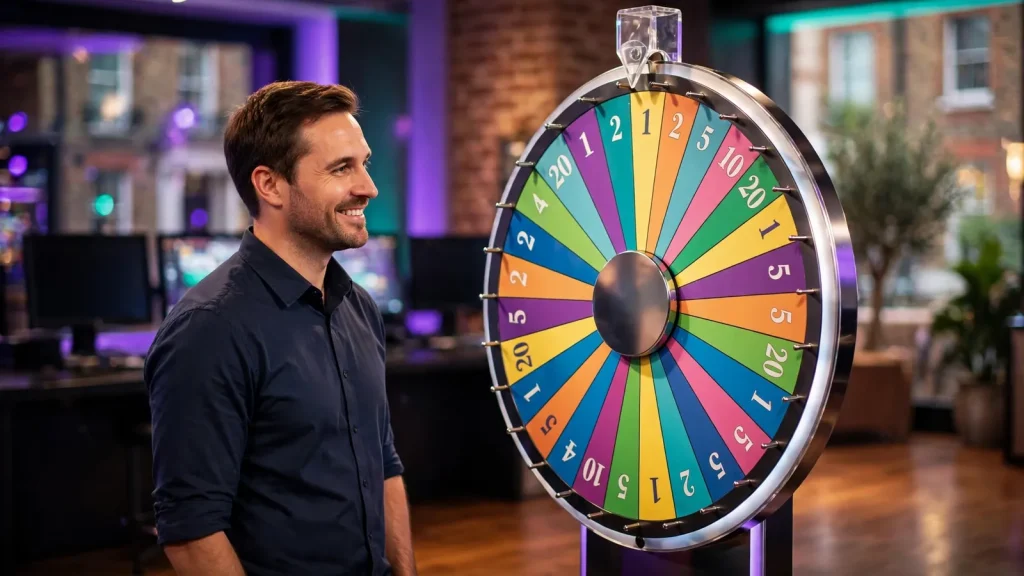
The guide separates the studio broadcast from software-led play and sets out practical points for comparing tables, demos and casino terms.
Table of Contents
- The Live Casino Format Behind the Search
- Dream Catcher in the UK Live Casino Landscape
- What Makes a Live Table Worth Comparing
- Playing a Live Game Through the Screen
- Roulette Wheels, Pockets and the House Edge
- Choosing a Live Casino Site Without a Rankings List
- What a Demo Can—and Cannot—Show
- A Review of the Live Format, Not an Unverified Game
- The Practicalities of Joining a Live Table
- Bonuses and the Cost of the Fine Print
- Jackpoty live casino
The Live Casino Format Behind the Search
The phrase “live Dream Catcher casino” points towards a particular kind of screen experience: not simply a game rendered by software, but a game shown as it happens in a studio. A human dealer is present in the footage, and players use an on-screen interface to place their bets. The distinction is easy to miss when both formats occupy the same casino website. One is produced entirely as a digital game; the other puts a real-time studio feed at the centre of play.
That change in presentation matters. A digital game can move from one action to the next without waiting for a person to deal, announce or operate anything. A live dealer game has a human rhythm. The footage shows activity as it unfolds, while the interface gives remote participants a way to take part. The screen is therefore doing two jobs at once: carrying the studio into the player’s space and receiving the player’s decisions in return.
The arrangement is less like watching a recording than joining a broadcast in which the betting interface remains active. The dealer is not a decorative figure added to a computer game. The live feed is the visible setting for the game, and the dealer’s presence makes the event legible as something taking place in real time. On the other side of the screen, bets are entered digitally. Physical action and electronic participation meet, though not in the same room.
This is the useful context for anyone looking at a Dream Catcher online casino. The name may lead to a specific game, but the broad format can be described without assuming how that game works. A live listing signals a studio-based experience with a human dealer and an interface for betting; it does not, by itself, establish the game’s rules, possible outcomes or particular features. Those belong to the game’s own explanation, not to the label “live”.
Live Baccarat Online in the UK: Rules and Tables
The format also changes the tempo. Live games move more slowly than digital versions, in part because the action is presented through a real-time studio feed rather than compressed into a rapid sequence of software responses. The pauses are not merely empty space. They are part of the transaction between what happens in the studio and what players do on screen. A live table must leave room for the people involved to follow the action and make their choices.
That slower rhythm can feel like a small return of ceremony to a medium usually designed to remove it. Digital play tends to make speed look like efficiency: the next event is ready almost before the previous one has ended. A live studio cannot quite pretend that people do not take time. The dealer remains in view; the game advances at a pace shaped by an unfolding event. It is a modest human presence, but a persistent one.
There is a practical cost to that presence. Live games have higher minimum bets than digital versions, so the difference is not only visual or atmospheric. The format asks for a greater starting commitment at the table, even as it slows the sequence of play. That combination helps explain why a live option is not simply a more elaborate skin for the same digital experience. It changes both the way the game is presented and the conditions under which a player joins it.
The stream also depends on a stable internet connection. A studio feed has to travel continuously to the screen, while the betting interface must remain usable alongside it. If the connection is unreliable, the two parts of the experience can become difficult to follow together. This is not a special quirk of one named game; it follows from the basic design of live dealer play. A real-time event needs a real-time link.
Attention: A live dealer experience requires a stable internet connection to ensure the studio feed and betting interface remain synchronized.
The attraction, then, is not reducible to the presence of a dealer. It lies in the arrangement: an actual studio, unfolding footage, human operation and digital betting gathered into one screen. For someone considering whether to play Dream Catcher online, that distinction is more useful than assumptions drawn from the title alone. The live label describes how the experience is delivered, not a promise about what the game contains or what a player will get from it.
There is a curious social compromise here. Online casinos remove the shared room, its journey, its furniture and its incidental company, then restore a narrow view of human activity through a camera. The dealer becomes the public face of a private session; the interface turns participation into a set of on-screen choices. It is neither the old casino floor nor an entirely solitary digital mechanism. It is a broadcast with a wager attached.
The appeal of Dream Catcher online casinos, where the game is offered in live form, therefore sits within this larger format. The studio lends the screen a sense of occasion; the interface makes the occasion actionable. But the live version remains slower, more demanding of the connection and higher in minimum stakes than its digital counterpart. The atmosphere has its price.
Dream Catcher in the UK Live Casino Landscape
When considering a live Dream Catcher casino in the UK in 2026, withdrawal timing is one practical detail to check. This reference card highlights the stated payout speed for each operator.
1. NightLuck
Payout speed: 1-3 business days NightLuck lists a payout speed of 1–3 business days.
2. x3bet
Payout speed: 1-3 business days x3bet lists payouts as taking 1–3 business days.
3. Chanze
Payout speed: 1-3 business days Chanze states a payout speed of 1–3 business days.
4. Amunbet
Payout speed: 1-3 business days Amunbet gives a payout timeframe of 1–3 business days.
5. BeOnBet
Payout speed: 1-3 business days BeOnBet lists payout processing at 1–3 business days.
6. SlotoSport
Payout speed: 1-3 business days SlotoSport states that payouts take 1–3 business days.
7. SpinFormula
Payout speed: 1-3 business days SpinFormula lists a payout speed of 1–3 business days.
8. Zombillion
Payout speed: 1-3 business days Zombillion gives a stated payout timeframe of 1–3 business days.
9. Britsino
Payout speed: 1-3 business days Britsino lists payouts as taking 1–3 business days.
10. NightWin
Payout speed: 1-3 business days NightWin states a payout speed of 1–3 business days.
A game name can travel faster than the conditions under which it is offered. “Dream Catcher” may appear in a casino menu, in a discussion of live tables or in a search for a particular kind of evening entertainment. In the United Kingdom, however, the first question about any live casino is not what its title suggests. It is whether the operator holds the licence required to offer gambling legally to people in the UK.
That requirement gives the market a boundary. Live dealer casinos are legal in the UK when they hold a licence from the UK Gambling Commission. The licence attaches to the operator, not to the appeal of a game name, and a familiar label cannot stand in for it. A listing that looks polished, or a game that is described as live, does not by itself establish that the casino offering it is authorised for this market.
The distinction is less theatrical than the product names, but more consequential. Casino branding invites attention to the table; regulation asks who is permitted to provide it. For a UK player looking at Dream Catcher, the relevant setting is therefore a licensed casino environment. The phrase “Dream Catcher casino UK” may describe what someone hopes to find, but the phrase alone says nothing about the status of a particular operator.
This is a recognisable feature of British gambling regulation: legality is tied to the business providing the service. The UK Gambling Commission’s role is not a decorative seal on a casino’s presentation. Its licence is the condition that separates a legal live dealer casino serving UK customers from an offer that has no such authorisation. The rule is straightforward, even if the online market makes the boundary easy to overlook. A game tile and an operator’s legal standing are different things.
That distinction matters especially when a name circulates across multiple sites. The plural idea of “Dream Catcher casinos” can make the game sound like a single, standardised destination, as though every result leads to the same product under the same terms. In reality, a name in a menu identifies neither the operator’s licence nor the precise conditions of its offer. The UK market is not made lawful by the popularity of a title. It is made lawful by the required licence.
Legal Compliance
Live dealer casinos are legal in the UK only if the operator holds a valid licence from the UK Gambling Commission.
There is also a cultural contrast in the way online casinos present themselves. Their interfaces tend to make the experience feel immediate and self-contained: a game is there, a button is there, and the screen seems to settle the matter. Regulation restores the part of the picture that the interface leaves outside the frame. Behind an online casino is an organisation, and in the UK that organisation must meet the licensing condition to offer live dealer gambling legally. The screen may conceal the institution; the law cannot.
For that reason, “live Dream Catcher casino” is best understood as a description of a hoped-for category, not proof of a particular legal offer. The same applies to “Dream Catcher live casino UK”: those words may point towards a live game in a UK-facing casino, but they do not certify the casino. A title is not a licence. A menu is not a regulator. The distinction is plain.
This does not turn the game name into a mystery, nor does it establish anything about the game’s rules or features. It simply places the subject in its proper market context. The UK question is whether the operator offering a live dealer casino holds a UK Gambling Commission licence. That condition applies to the casino’s legal position; it cannot be inferred from the word “live”, from a UK-themed page, or from a game’s branding.
The phrase “live Dream Catcher casino UK 2026” brings together a game name, a market and a year, but those elements do not alter the legal test. A current-looking page is not evidence of authorisation, and a title that appears in a casino menu does not make every site carrying it equivalent. The useful distinction remains between the entertainment being advertised and the operator legally supplying it.
Live Casino Lightning Roulette in the UK
In a crowded online market, that is a modest but important form of clarity. Game names draw the eye; licensing establishes whether the offer belongs in the UK’s legal live casino landscape. The order matters. A name may begin the search for a casino, but the operator’s UK Gambling Commission licence is what makes the offer lawful. Branding can be persuasive. The condition is not.
What Makes a Live Table Worth Comparing
The phrase “best live Dream Catcher casino” suggests a simple contest: find the table with the most attractive name and settle in. Yet a live table is not just a game label. Its practical value depends on the conditions around play: how quickly a round moves, what the minimum stake permits, whether the connection can carry a continuous stream, and how the game is treated under a promotion’s rules. These details matter more than an unsupported winner’s badge.
Pace is the first difference a comparison should make visible. Live games tend to move more slowly than digital versions because a human dealer conducts the action in real time. That rhythm can make the experience feel more social and legible, but it also means fewer rounds can pass in the same stretch of time. A player comparing a Dream Catcher table with a digital casino game should not assume that the two offer equivalent speed simply because they appear on the same screen. The dealer sets the tempo. No instant replay of a round.
Live games move more slowly than digital versions because they are conducted by a human dealer in real time, meaning fewer rounds occur in the same period.
That slower pace changes the shape of a session. Decisions and outcomes arrive in sequence, while the studio feed continues to occupy attention. A table may suit someone who values visible, human-led play; it may frustrate someone who prefers quick cycles and little interruption. Neither preference is a measure of skill. It is a question of how time is spent, and of how much of that time is attached to a stake. A preset budget, decided before play and kept to, helps prevent the session’s pace from becoming an excuse to extend it.
Minimum stakes are another useful comparison point, but they should not be treated as a stable property of every table carrying the same game name. Live games have higher minimum bets than digital versions. The actual entry point is a table condition, not a promise made by a search result or a general label. A low advertised threshold can be irrelevant if it belongs to a different table, while a higher minimum can rule out a session that would otherwise fit a modest budget. The number displayed at the table is the meaningful one.
That distinction is especially important for a search about Dream Catcher. The name alone cannot establish the minimum stake, pace, or promotional treatment attached to a particular live table. A comparison therefore works best when it is grounded in the specific conditions shown where play is offered, rather than assumptions carried over from another game or another version. The same title does not make every practical detail interchangeable.
Crazy Time Live Casino Game Show in the UK
The connection is part of the table too. Live play requires a stable internet connection because the experience depends on a real-time stream as well as the betting interface. An unstable feed can interrupt the view of proceedings and make the timing of a decision less comfortable. This is not a decorative technical concern: unlike a digital game that can run without a live studio picture, a live table relies on that continuous link. A comparison that says nothing about the demands of streaming describes only half the experience.
Promotions introduce a different kind of comparison. Live games often count for only a small share of bonus wagering requirements; a stated example is a ten per cent weighting. That means a wager at a live table may reduce a promotion’s outstanding requirement much less than a wager on a game with full weighting. The percentage is not universal, and the relevant terms belong to the particular offer. Treating a bonus headline as though it applied equally across every game is a reliable way to misunderstand its value.
Welcome offers also need to be read by game category, not by their headline alone. A specialist review describes many UK welcome offers as slot free spins that cannot be used at live tables. That is a source-specific observation, not a guarantee about every current promotion. The practical comparison is the written offer: whether live play is eligible, what contribution it receives, and whether other conditions affect the calculation. A generous-looking offer may have little bearing on a live session.
Do
- Check if live play is eligible for the promotion
- Verify the contribution weighting for live tables
- Read the full terms for wagering requirements
Don’t
- Assume welcome free spins apply to live tables
- Treat a bonus as money already earned
- Rely solely on a promotion’s headline value
The useful comparison, then, is not a league table of supposedly superior Dream Catcher casinos. It is a check of fit: pace, minimum stake, stream reliability and the terms attached to any promotion. Those factors say more about whether a table suits a particular style of play than a broad label such as “best” can. They also resist the familiar temptation to treat a bonus as money already earned. It is not.
Any discussion of live tables is entertainment information, not gambling advice. The comparison can clarify the conditions of play; it cannot turn chance into certainty or make a stake risk-free.
Playing a Live Game Through the Screen
A live session has two parts on display: a studio feed and an on-screen betting interface. The feed carries real-time footage of a human dealer and the game taking place in the studio. The interface is where players submit their bets. One part is watched; the other is used.
That division changes the character of the screen. In a digital casino game, the action is generated by software and presented as a finished visual experience. In a live dealer game, the image comes from an actual studio, while the player’s decisions still travel through digital controls. The screen is therefore neither simply a window nor simply a game board. It is both, with a human performance on one side and a set of electronic choices on the other.
Live Blackjack Online Casinos in the UK: How It Works
For someone looking up the Dream Catcher game in a casino, that distinction helps explain what “live” means in practice. The phrase describes the delivery of the game: a dealer and gameplay are streamed as they happen, while bets are made through the interface. It does not turn the player into a participant standing beside the studio table. The contact is mediated by the screen, and the controls remain digital.
The sequence is straightforward at this level. The studio image shows the dealer and the ongoing action. The player-facing interface presents the means of placing a bet. The session unfolds through those two channels together: the stream makes the game visible, and the interface carries the player’s choices into it. The dealer is physically present in the studio; the player’s action is not. A small distinction, but the whole arrangement rests on it.
This is why a live casino game can feel different from a simulated one even when both are played on the same device. The live image includes a person performing the work of dealing, rather than a software animation standing in for that activity. The interface, meanwhile, keeps the familiar grammar of online play: selections are made on screen, not across a felt table. The old casino room has been divided into broadcast and control.
There is a social oddity in that division. A dealer appears in real time, yet the player encounters that person through a camera and a digital betting layer. The human presence is genuine; the surrounding encounter is engineered for remote use. Casinos have long arranged games around visible ritual—hands dealt, wheels turned, bets acknowledged. Streaming carries some of that visible ceremony into private rooms, while the interface translates participation into taps and selections.
How the live interface works
The screen is divided into two functions: a real-time studio feed showing the human dealer and the game action, and a digital betting interface where players submit their choices.
To play Dream Catcher through a live casino, then, is to enter this two-part arrangement: observe a studio feed and use the on-screen controls to place bets. The important movement is not from one room to another, but from image to interface and back again. The dealer’s actions give the stream its human centre; the betting panel gives the remote player a way to take part. Neither element alone makes the session. Together, they form the particular grammar of live play.
It is a compact bargain between presence and distance. The studio supplies the visible human event; the screen supplies access to it. The player remains elsewhere, connected by a feed and a set of controls. A casino, reduced to its essential interface—and still unmistakably a performance.
Roulette Wheels, Pockets and the House Edge
The word “wheel” can point to rather different things in a live casino. In live dealer roulette, a dealer sets a physical wheel spinning and the ball settles into one of its pockets. Computerised roulette replaces that visible wheel with a Random Number Generator, which determines the result electronically. The distinction is about how the outcome is produced, not a promise that one format is more predictable than the other.
Deal or No Deal Casino UK: Slot Format Explained
That matters when a search for a Dream Catcher wheel leads towards roulette information. A wheel-shaped game or a live studio presentation should not be assumed to follow roulette rules: the presence of a wheel does not make every game roulette. Roulette’s defining structure is the numbered wheel and the wager on where the ball will land. If the selected number is where the ball comes to rest, the bet wins.
Pocket colours help explain why roulette tables are not all mathematically alike. European Roulette has a single green pocket, marked zero. American Roulette adds a second green pocket, marked double zero, or 00. That extra stopping place changes the chance of a straight number winning: the odds are one in 37 on a European wheel and one in 38 on an American wheel. The difference is small in appearance, but the wheel has no obligation to make small differences harmless.
The house edge expresses the casino’s mathematical advantage over time; it is not a forecast of what will happen in a particular spin. Those percentages describe the stated roulette rules, not a guaranteed loss on an individual bet. A short run can depart sharply from the long-run mathematics. Chance is not a bookkeeper.
There is also a variation in how zero affects certain wagers. In French Roulette, an even-money bet—such as red or black—loses only half its stake if the ball lands on zero. That rule softens the result for that category of bet; it does not remove the zero from the wheel or turn the outcome into a win. The precise table rules therefore matter alongside the label on the game.
European Roulette
Features a single green pocket marked zero, offering odds of one in 37 for a straight number.
American Roulette
Includes a second green pocket marked double zero (00), resulting in odds of one in 38 for a straight number.
French Roulette
Includes a rule where even-money bets lose only half their stake if the ball lands on zero.
A live dealer roulette table offers a physical wheel in view; a computerised version relies on its random-number system. Neither presentation changes the need to distinguish European from American pockets, or one class of wager from another. For anyone arriving through searches for a live casino wheel, those are the useful questions beneath the visual appeal: what determines the result, how many green pockets are present, and which stated edge applies to the chosen bet. A wheel is theatre, too—but the arithmetic keeps its seat.
Choosing a Live Casino Site Without a Rankings List
A live casino site is not simply a window onto a studio. It is also the operator responsible for offering gambling in a particular market, and in the UK that responsibility has a clear boundary: a casino serving UK players must hold a current operating licence from the UK Gambling Commission. A polished stream cannot substitute for that condition. Regulation is less theatrical than a dealer at a table, but it matters more.
That makes licensing the first distinction when considering a site associated with Dream Catcher. The name of a game, or the fact that it appears in a live casino, does not establish that the operator is authorised to serve the British market. The relevant question concerns the site itself. In the UK, legal online gambling is offered through licensed and regulated operators; the licence is part of the setting, not a decorative badge.
The second consideration is whether the live format suits the available connection. A studio stream depends on a stable internet connection, so interruptions can disturb the view of a round and the timing of play. This is not a peculiarity of one game. It follows from watching real-time footage rather than relying solely on a digital version. The screen has become the room, with all the room’s dependence on the wire.
Monopoly Live Casino UK: How Online Play Works
Pace also changes the character of a session. Live games tend to move more slowly than digital versions, while their minimum bets are higher. A site may therefore be legally suitable and technically accessible yet still offer a format that feels less flexible than a purely digital game. The presence of a familiar title does not erase those practical differences.
A useful assessment stays with these basics: whether the operator holds the required UK licence, whether the connection can sustain a live stream, and whether the slower rhythm and higher minimum stakes fit the intended setting. None of those points predicts a result. They describe the conditions under which play takes place.
This page is for entertainment purposes only and is not gambling advice.
What a Demo Can—and Cannot—Show
A demo label can suggest a way to view a game without treating the session as ordinary real-money play. It does not, by itself, establish what is being shown. In particular, the word does not prove that a Dream Catcher demo is available, that it uses a live studio feed, or that any result could become a real payout.
That distinction matters because a live dealer game has a specific format: gameplay is streamed in real time from a studio, where a human dealer is present, and bets are submitted through an on-screen interface. A demo experience should not be assumed to reproduce that arrangement. It may offer a different kind of presentation, or the label may refer to an option whose details depend on the site. The name alone settles none of this.
A demo label describes a mode of access; it does not guarantee that the experience uses a live studio feed or that results can lead to real payouts.
A live casino demo, where one is offered, is therefore not a promise of access to a live table. Nor does a familiar-looking screen establish that a dealer is dealing in real time. The visible interface and the underlying format are separate matters. A studio stream shows an event unfolding; a demo label describes a mode of access, not necessarily the source of the images or the status of the bets.
The same caution applies to expectations about winnings. A demo should not be treated as a route to real payouts, and viewing a game does not turn its outcomes into money. Any terms attached to an actual account or table are a separate matter; the word “demo” cannot replace them.
For anyone investigating a Dream Catcher demo, the useful distinction is modest but important: a demonstration may help explain a presentation, while a live dealer game is defined by real-time studio gameplay and bets placed through the interface. Those are not interchangeable descriptions. A label is not a live dealer. This page is for entertainment purposes only, not gambling advice.
A Review of the Live Format, Not an Unverified Game
A review of Dream Catcher in a live casino has to begin with the kind of experience being assessed. The live format places a human dealer and a studio performance at the centre of play; bets are entered through an on-screen interface while the action is streamed in real time. That combination gives the screen a social presence absent from a purely digital game, though it does not turn online play into a visit to a casino. The dealer is visible; the room remains elsewhere.
That distinction matters because the appeal is partly theatrical. A person conducts the game in front of a camera, and the stream makes the event feel shared rather than generated solely by software. The interface, meanwhile, keeps the practical business of betting within the same frame. It is a hybrid arrangement: human performance on one side, digital controls on the other. Neither cancels out the other.
For anyone considering a Dream Catcher live casino review, the format can therefore be judged without pretending that every title offers the same experience. The dealer’s presence is a genuine feature of live play, but it is not a promise of conversation or personal attention. The stream is made for a table of participants, not a private exchange. Its value lies in seeing the game conducted in real time, rather than in any imagined intimacy with the person dealing.
The trade-off is pace. Live games move more slowly than digital versions, because the play unfolds through a human-led broadcast rather than an instant digital process. That may suit those who prefer a visible performance, but it leaves less room for rapid repetition. Slower is not automatically more thoughtful; it is simply slower.
There is also a practical dependence on a stable internet connection. A live experience relies on the stream arriving clearly and consistently, so connection quality is part of the format rather than an incidental technical detail. A human dealer cannot make a disrupted feed feel seamless.
Summary of Live Format
- Presence is prioritised over speed, resulting in a slower pace of play
- Higher minimum bets are typically required compared to digital versions
- A stable internet connection is essential for a seamless studio stream
- The experience is a hybrid of human performance and digital controls
The format earns its appeal through presence, not speed. Its costs are equally plain: slower play, higher minimum bets than digital versions, and dependence on a stable connection. That is a mixed verdict, not a flaw hidden in the small print. A live table offers a different texture of play, and the difference is the point.
The Practicalities of Joining a Live Table
Taking a seat at a live Dream Catcher table begins with a simple distinction: the picture is not the game interface. A studio camera carries the dealer and the action in real time; bets are entered separately, through controls on the screen. That division is easy to overlook until the pace of the studio makes it visible.
A digital game can move from one result to the next without waiting for a person to complete each step. Live play cannot. The dealer has to conduct the round, and the stream has to show it. A pause is part of the format, not necessarily a technical fault. Those choosing to play Dream Catcher live casino should expect a rhythm shaped by the studio rather than by an instant sequence of computer-generated outcomes.
The connection matters because the video is not decorative. It is how the table’s progress reaches the player, and a stable internet connection is needed to follow it. A feed that breaks up can make the on-screen betting window and the action harder to keep in step. This is a practical requirement, not a promise that any particular device or connection will perform well.
The interface also asks for attention of its own. The dealer is visible in one part of the screen, while the betting controls sit elsewhere; action has to be entered through those controls. Live tables also have higher minimum bets than digital versions, so the change is not only about waiting for a round to unfold. It affects the terms on which participation begins.
Online American Roulette in the UK: Wheel and Odds
Nothing especially mysterious is required: a working stream, a usable interface and patience with a human pace. The studio supplies the ceremony. The screen still takes the bets.
Bonuses and the Cost of the Fine Print
A welcome offer can look generous on a banner and prove rather less useful at a live table. A specialist review of UK promotions describes most welcome offers as free spins on slots, which cannot be used at live tables. That distinction matters for anyone drawn to Dream Catcher: a promotion attached to a casino does not necessarily apply to every game it hosts.
The second obstacle is contribution weighting. Live games may count for only a small share of the wagering attached to a bonus; one stated example is a 10% weighting. In practical terms, eligible stakes on a live game can make much slower progress towards the requirement than the same amount of play on a game with full weighting. The offer’s headline value says little about that arithmetic.
Fine print is where the offer becomes an actual set of conditions. The terms should be checked for which games qualify, how each game contributes, any wagering requirement and any maximum bet limit while the bonus is active. A game may be available on the site yet excluded from a promotion, or included only at a reduced weighting. Availability and eligibility are separate matters.
For a search for the best online casino with Dream Catcher, the useful comparison is therefore not the size of a welcome banner alone. It is whether the promotion can be used on the intended live game, and how much its play counts. If the terms do not make that clear, the advertised value is difficult to assess.
A bonus is not extra money without conditions. It is a contract with decorative lettering. Entertainment, not gambling advice; a budget set before play should remain the limit, whether a promotion is active or not.
How does the house edge change between games?
It varies by bet and game. In roulette, straight-up bets have a 2.9% house edge, while other bets have a 2.7% edge; French Roulette reduces the loss on an even-money bet when the ball lands on zero.
Why does the dealer always win in blackjack?
The dealer does not always win. Players try to beat the dealer with a hand totalling 21 or less, although blackjack still has a house edge.
How do you play live roulette?
Place bets through the on-screen interface while a dealer spins a physical wheel. You win when the ball lands on a number you selected.
How can you win live dealer roulette?
Choose a roulette bet that wins for the number where the ball lands. The odds differ by wheel: American Roulette has 38 pockets, while European Roulette has 37.
Jackpoty live casino

Live Casinos in the UK: How Online Tables Work
Live casino games broadcast dealers and table play through an online interface, but the format...

Crazy Time Live Casino Game Show in the UK
A look at the studio-and-interface format, UK casino context and the limits of claims about...

Deal or No Deal Casino UK: Slot Format Explained
The guide distinguishes the familiar Banker-and-briefcase premise from slot features, bonus searches and what free...

French Roulette Online Casino UK: Rules and Play
French roulette combines a single zero with La Partage on eligible even-money bets, alongside live...

Live Baccarat Online in the UK: Rules and Tables
A practical look at live-table mechanics, betting costs, stream quality and the UK licensing context....

Live Blackjack Online Casinos in the UK: How It Works
A live dealer runs the physical game in a studio while players follow the stream...

Live Casino Lightning Roulette in the UK
A live stream connects a physical dealer and wheel to digital betting controls, while computerised...

Live Roulette in the UK with English-Speaking Dealers
A look at the live studio setup, betting interface, wheel formats and the limits of...

Monopoly Live Casino UK: How Online Play Works
The format pairs a real studio and dealer with screen-based wagers, while rules and availability...
Online American Roulette in the UK: Wheel and Odds
The double-zero pocket distinguishes American roulette and shapes how its live tables, bets and payouts...

European Roulette at UK Online Casinos: Rules and Play
A guide to European roulette’s single-zero wheel, betting options and the differences between online spins...
































































































































































































































































