
Trustworthy Online Casinos in the UK: How to Check
 Available in GB
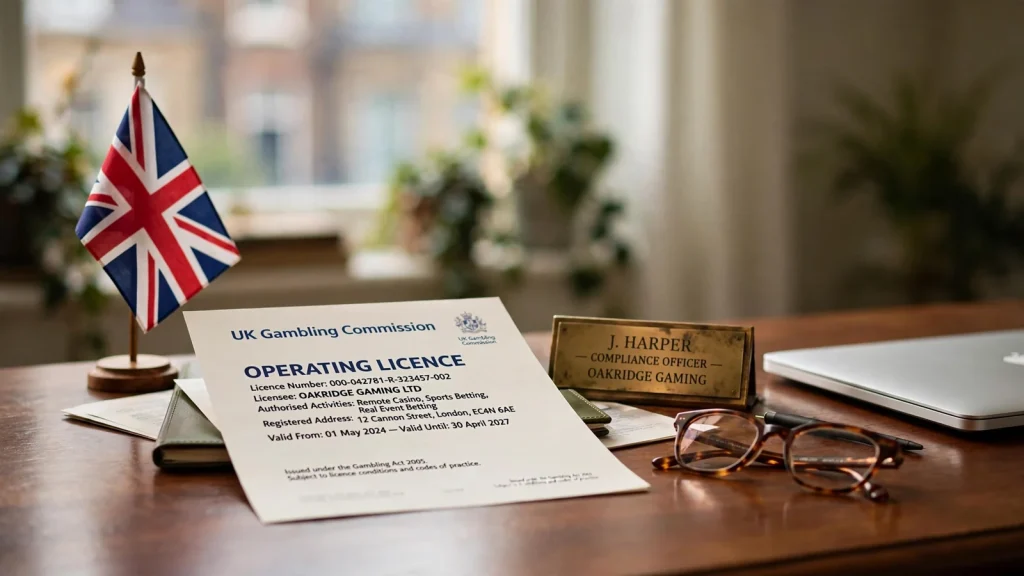
A practical look at licensing, player controls, payment terms and complaint routes in the British gambling system.
Table of Contents
- What a UK Gambling Commission Licence Does—and Does Not—Tell You
- Trust Begins Before the First Deposit
- GAMSTOP and the Boundaries of the British System
- Real-Money Trust Is Also About Control
- Online Slots Under Rules Designed to Slow the Spin
- Payments, Withdrawals and the Cost of Waiting
- When a Welcome Offer Is Less Generous Than It Looks
- Reading Casino Reviews Against the Regulatory Record
- Can an Online Casino Be Trusted Without a UKGC Entry?
- Checking the Public Register—and Knowing Where to Complain
- Safety
What a UK Gambling Commission Licence Does—and Does Not—Tell You
A UKGC Licence is the legal starting point for assessing an online casino that offers real-money gambling to people in Great Britain. The rule follows the customer-facing service, not the operator’s address: a business based abroad still needs the relevant Gambling Commission licence if it provides remote gambling facilities to consumers in Great Britain. For customers in England, Scotland and Wales, an operator offering real-money gambling must hold that licence.
That distinction matters because a company’s registered location can sound more reassuring than it is. A British-facing website does not become part of the British regulatory system simply by using familiar language, displaying prices in pounds or accepting customers from the country. What counts is whether the business has the permission required to serve this market. The map on the company’s paperwork and the map of its customers are not the same thing.
The Commission regulates remote gambling offered to consumers in Great Britain. A UKGC Licence therefore identifies an operator as one that is permitted to provide the relevant service within that system. It is a meaningful threshold, not a decorative badge. A casino without the required licence cannot be treated as a lawful British online casino merely because its own website describes it as trustworthy.
Choosing an online casino calls for checking practical details as well as its overall appeal. This list notes the payout timing available for each operator, which can help inform your research.
1. NightLuck
Payout speed: 1-3 business days NightLuck lists a payout speed of 1–3 business days. This gives readers a stated timeframe to consider when researching the operator.
2. x3bet
Payout speed: 1-3 business days x3bet lists a payout speed of 1–3 business days. It is a useful detail to keep in mind when assessing the operator.
3. Chanze
Payout speed: 1-3 business days Chanze lists a payout speed of 1–3 business days. This provides a concrete payout detail for readers considering the operator.
4. Amunbet
Payout speed: 1-3 business days Amunbet lists a payout speed of 1–3 business days. Readers can use this stated timeframe as one part of their research.
5. BeOnBet
Payout speed: 1-3 business days BeOnBet lists a payout speed of 1–3 business days. This stated timing is a practical detail to consider.
6. SlotoSport
Payout speed: 1-3 business days SlotoSport lists a payout speed of 1–3 business days. That gives readers a specific payout timeframe to take into account.
7. SpinFormula
Payout speed: 1-3 business days SpinFormula lists a payout speed of 1–3 business days. This is a useful practical point to include in your assessment.
8. Zombillion
Payout speed: 1-3 business days Zombillion lists a payout speed of 1–3 business days. Readers can factor this stated timeframe into their research.
9. Britsino
Payout speed: 1-3 business days Britsino lists a payout speed of 1–3 business days. This provides a specific detail for readers evaluating the operator.
10. NightWin
Payout speed: 1-3 business days NightWin lists a payout speed of 1–3 business days. The stated timeframe is one practical factor to consider.
What the licence establishes
The licence establishes a relationship between the operator and the regulator. The operator is not simply presenting itself to the public on its own terms; it is operating under the framework administered by the Gambling Commission. This is the institutional difference between a trustworthy online casino in the British market and a business making a trust claim without the local permission needed to serve customers here.
The requirement applies regardless of where the business is based. That closes an obvious gap: without it, an operator could argue that its location put it beyond the rules, even while deliberately offering gambling to people in Great Britain. Instead, access to this market carries a licensing requirement. A foreign address does not, by itself, remove that requirement.
This is a relatively plain principle, though the online world is adept at making plain principles look negotiable. A site can look polished and speak the language of customer care; neither appearance substitutes for permission. In a market where the service crosses borders more easily than its accountability does, the licence supplies a legal point of reference.
What it cannot establish
A licence is not a promise that every interaction with an operator will be satisfactory. It does not tell the whole story of how a particular account will be handled, nor does the word “licensed” make every promotional claim or customer experience automatically reliable. It answers an important question about regulatory status. It does not answer every question about conduct.
Merkur Casino Online in the UK: Games and Licensing · Curaçao Casino Licence UK: What It Means
That is why “trustworthy” should not be treated as a synonym for “licensed”, even though a current UKGC Licence is an essential baseline for legal real-money gambling in Great Britain. Trust is a broader judgement than legal eligibility. A licence can tell a customer that the operator belongs within the Commission’s regulatory system; it cannot, on its own, settle the quality of every decision the operator makes.
The distinction cuts both ways. A business’s confident language is not proof of its status, while the existence of a licence is not a personal endorsement of every feature it offers. Regulation creates a framework of accountability. It does not turn uncertainty into certainty, or make judgement unnecessary. No badge can do that work unaided.
The most trustworthy online casino in the UK is therefore not identified by a slogan about trust. The relevant first question is whether the operator holds the licence required to offer real-money gambling to customers in Great Britain. After that, separate questions about the operator’s practices and the protections available to customers still matter. The legal baseline is necessary, but it is not the whole measure.
Regulatory Baseline
A UKGC Licence is an essential legal baseline for real-money gambling in Great Britain, but it is not a complete measure of an operator’s quality or trust.
There is also a difference between the Commission’s role and the operator’s own responsibility. The regulator oversees remote gambling within its remit; the operator provides the service. Treating the presence of a regulator as if it personally guarantees each transaction would confuse supervision with direct management. The licence locates responsibility within a regulated system. It does not make the regulator the casino.
For anyone comparing trustworthy casinos, that is the useful boundary to keep in view: licensing is evidence of permission and regulatory inclusion, not a universal certificate of virtue. It filters out a basic legal uncertainty, while leaving the more specific assessment of an operator to other evidence. A necessary beginning. Not a verdict.
Trust Begins Before the First Deposit
A casino account begins with a small administrative interruption. Before money enters the account and before play begins, the operator must verify the customer’s age and identity. This is not a courtesy offered by a particularly conscientious business. It is part of the conditions for gambling online in Britain. An account that invites a deposit before those checks are complete is not demonstrating trustworthiness; it is asking for trust while postponing the work that should support it.
Age checks have a clear purpose: gambling is not for children. Identity checks serve a broader one. They connect an account to a real person, rather than leaving the operator to treat a username, an email address and a payment detail as if they formed a complete identity. The process can feel unceremonious, even tiresome. But a trustworthy casino is not simply one that makes entry effortless. Some friction is the point.
Casino Without a UK Licence: What It Means · USA Casinos for UK Players: Licensing and Risks
That distinction matters because a polished registration page can create an impression of care without establishing much about the person opening the account. A neat design, quick sign-up or confident promise says little about whether the account holder has been properly identified. Verification asks for evidence rather than atmosphere. It is one of the few moments when the relationship between an online business and a customer has to move beyond the screen’s decorative assurances.
The documents commonly involved are familiar: a photograph of a passport or driving licence, together with a recent utility bill. The first helps establish identity; the second can help establish an address. These are not interchangeable scraps of paperwork, and a name typed into a form is not the same thing as evidence supporting that name. The precise request can depend on the operator and the account circumstances, so a general description should not be mistaken for a promise that every customer will be asked for exactly the same items.
The timing is less ambiguous. Verification has to take place before a customer can deposit or play. A site may let someone begin registration, but that is not the same as permission to gamble first and settle identity questions later. The distinction is important: a customer should not have to discover, after money has been committed or play has begun, that the account was never ready to be used.
Do
- Complete identity and age checks before depositing
- Provide a passport, driving licence, or utility bill
- Ensure verification is finished before play begins
Don’t
- Deposit money before identity checks are complete
- Treat a neat registration page as proof of care
- Accept vague assurances that an account is “verified”
There is a social history in this small pause. Gambling has often been presented as a private transaction between an individual and a game. Online, the transaction is mediated by an account, records and checks. That arrangement can seem impersonal, but it also makes responsibility harder to hide behind the old image of a lone player at a table. Before play starts, the operator must know who is being admitted. The ritual is bureaucratic. Its purpose is not merely ceremonial.
For anyone comparing what online casinos are trustworthy, the way verification is explained can therefore be more revealing than the speed of registration. Clear information should describe what documents may be requested and when the checks must be completed. Vague assurances that an account is “verified” do not explain what has actually happened. Nor does a request for documents, by itself, prove that every part of an operator’s conduct is sound. It is a meaningful step, not a universal certificate of virtue.
A sensible account process also makes the request intelligible. If a customer is asked for identity evidence, the reason should be connected to establishing who holds the account, rather than wrapped in unexplained language. The distinction is useful when digital transactions make impersonation and mistaken identity less visible than they would be face to face. A screen can display a name; it cannot, on its own, establish that the person behind it is that name.
International Casinos for UK Players: Key Risks
This applies regardless of the currency or payment technology used. A casino described as an Ethereum casino does not escape the basic question of who is opening the account. A cryptocurrency label may alter the way money is represented, but it does not turn an account into an anonymous permission to gamble. Trust should rest on the operator’s handling of identity and age checks, not on the novelty of the payment method or the suggestion that new technology makes old responsibilities disappear.
There is also a boundary to what these checks can prove. Documents can help connect an account to a person, but completing a verification process does not establish that gambling will be harmless, that every future interaction will be straightforward, or that a casino deserves unqualified confidence. Trust is assembled from conduct over time. Still, the first step is basic: an operator should know who is being allowed to deposit and play, and should establish that before either begins.
The paperwork is not the relationship. It is the threshold.
GAMSTOP and the Boundaries of the British System
The phrase “not on GAMSTOP” can sound like a description of a casino’s character: independent, discreet, perhaps more accommodating. In Great Britain, it has a more practical meaning. The UK Gambling Commission requires online operators within its regulatory system to participate in GAMSTOP, the national online gambling self-exclusion service. Participation became compulsory on 31 March 2020. A British-facing operator cannot treat the scheme as an optional badge of virtue.
That rule connects an individual decision to stop gambling with the market’s licensing framework. GAMSTOP is not a separate regulator, nor does its existence certify that every other aspect of a participating operator is beyond criticism. It is one part of a system in which remote gambling operators serving Great Britain must meet the Commission’s requirements. The distinction matters: participation is a regulatory obligation, not a general promise of trustworthiness.
Regulatory Risk
Any operator providing remote gambling to customers in Great Britain under the UKGC regime must participate in GAMSTOP; those claiming otherwise deserve scrutiny.
A person looking for a trustworthy casino outside GAMSTOP may therefore be looking for something the British system is designed not to offer. If an operator provides remote gambling to customers in Great Britain under the UKGC regime, it must take part in the scheme. A site that presents itself as a British option while claiming to be outside that requirement deserves scrutiny, not an assumption that it has found a more trustworthy route. “Not on GAMSTOP” is not, by itself, evidence of independence in any admirable sense.
There is a human reason the rule exists. Self-exclusion is meant to make a decision made at one moment matter later, when the circumstances that prompted it may feel less urgent. A system that depends entirely on a person repeating that decision at every separate gambling site would place the burden back on the very person trying to create distance. A shared scheme turns that boundary into an expectation for participating operators. The policy is not sentimental. It is administrative, and that is part of its force.
The word “British” nevertheless hides a jurisdictional seam. The Gambling Act 2005 and the Gambling Commission’s remit cover Great Britain: England, Scotland and Wales. Northern Ireland is not within the Commission’s remote-gambling jurisdiction in the same way. The United Kingdom is a political name; it does not mean that one regulator’s rules automatically govern every part of it.
That distinction should not be mistaken for a loophole in the Great Britain system. It describes where the Commission’s authority applies, not a general exemption for operators serving customers in England, Scotland or Wales. Nor does it establish that a site outside the Commission’s remit is safe, unsafe, lawful or unlawful in every other respect. Northern Ireland has a different legal framework, and the UKGC’s participation requirement cannot simply be carried across as though jurisdiction were a matter of geography alone.
Non-UKGC Licensed Casinos: Regulation and Risks
The boundary is easy to blur in advertising and harder to ignore when a dispute or self-exclusion decision depends on which rules apply. “UK casino” can be a broad commercial label; the regulator’s jurisdiction is more precise. For Great Britain, the core point is clear: UKGC-regulated online operators must participate in GAMSTOP. Northern Ireland sits outside that particular regulatory arrangement.
That is the limit of the label. A casino’s absence from GAMSTOP does not make it a more trustworthy alternative for someone in Great Britain; it may instead indicate that the operator is not part of the framework applicable to British-facing remote gambling. A responsible assessment begins with the jurisdiction and the operator’s status, rather than with a reassuring description of what a site is not.
A boundary, not a recommendation.
Real-Money Trust Is Also About Control
A real-money account is not simply a doorway through which funds pass. It is also a small arrangement of choices: what messages arrive, what boundaries govern spending, and whether those boundaries can be changed without friction. Trust is partly a question of who holds those controls. An operator may set the architecture, but the account should not leave every decision in the operator’s hands.
Financial Controls
Limit reductions take effect immediately, while limit increases are subject to a cooling-off delay to prevent impulsive spending.
Promotions are one place where that distinction becomes visible. Casinos must give customers more control over the kinds of promotions they receive and the channels used to send them. The choice is not merely whether to accept a particular offer. It concerns the stream of prompts around the account: which forms of marketing are wanted, and where they may appear. That matters because an offer can be technically optional while repeated messages make it feel like the natural next step.
Control over promotion preferences is therefore more than tidying up an inbox. It gives the customer a say in how the commercial relationship behaves after registration. A trustworthy real-money online casino should make those preferences intelligible and usable, rather than burying them beneath the more prominent invitations to play. The quieter control is often the more revealing one.
Financial limits tell a similar story, though their logic is deliberately asymmetric. A limit reduction takes effect immediately. An increase is subject to a cooling-off delay. The difference is not an administrative quirk: it makes it easier to tighten a boundary than to loosen it in a moment of impulse. The system treats restraint as something that should be available at once, while a decision to permit more spending must wait.
That imbalance is purposeful. If every adjustment took equal effort, the account would be formally flexible but practically indifferent to timing. A delay on increases creates space between wanting a higher limit and receiving one; immediate reductions preserve the ability to step back without waiting for the operator’s timetable. It is a small piece of friction, placed on the direction where haste can matter most.
Offshore casino sites: UK legality, risks and terms
Remote operators must prompt new customers to set a financial limit before the first deposit and provide account-level controls that remain accessible. The word “accessible” matters. A limit that exists only in a policy page, or can be found only after navigating a maze, is less a working safeguard than a decorative promise. The point is not to make every account decision effortless. It is to make protective decisions reachable when they are needed.
These controls also help distinguish a trustworthy real-money casino from one that treats customer attention solely as an asset to be converted into further play. Promotional preferences give customers influence over contact; limit settings give them influence over the scale of their own activity. Neither removes risk, and neither can turn gambling into a dependable source of income. They do, however, show whether the account is designed to accommodate a person’s decision to pause, reduce, or decline.
The best criteria for trustworthy online casinos are not always dramatic. Some are found in the direction of a button, the immediacy of a limit change, or the ability to silence a particular kind of promotion. These are ordinary mechanisms, but they express an unusually important principle: control should not disappear once money has entered the account.
Small levers. Big difference.
Account Control
- Promotional preferences allow customers to manage marketing channels
- Immediate limit reductions preserve the ability to step back
- Cooling-off periods for limit increases create space for decision-making
- Accessible controls distinguish trustworthy operators from those prioritizing play
Online Slots Under Rules Designed to Slow the Spin
A slot’s pace is part of its design: one result disappears, another begins, and the interval between them can feel smaller than it is. In Britain, that interval is not left entirely to the software. Online slot spins must last at least 2.5 seconds, and autoplay is prohibited. The rules put a small, deliberate pause between one stake and the next.
That pause does not make a game harmless, or turn a fast-moving session into a safe one. It does, however, limit two features associated with uninterrupted play: rapid repeat spins and the removal of the decision to start each one. The distinction is modest but meaningful. A player has to initiate each spin, and the game cannot compress its cycle below the prescribed duration.
A stake limit tied to age
The maximum stake for a single online slot spin depends on the player’s age. Customers aged 25 and over may stake no more than £5 per spin; for those aged 18 to 24, the ceiling is £2. These are statutory limits, not settings an operator can raise through a promotion or a player can switch off in an account menu.
Age changes the permitted stake, but not the underlying character of the game. A lower ceiling is a constraint on how much can be placed on one spin, not a promise about how long a session will last or what it will cost in total. The rules address particular points of risk; they do not remove the player’s exposure to loss. A limit is not a shield.
Non-GamStop European Casinos: UK Rules Explained
That is why the phrase “trustworthy online slots” needs care. A game may operate within the rules and still involve chance, repeated staking and the possibility of losing money. Trust, in this narrow sense, is better understood as confidence that the product’s basic play conditions are not being allowed to run beyond the legal boundaries. It is not a judgement that a slot is fair to every player in every session, nor a prediction of a result.
The rules also draw a distinction between age groups rather than treating adults as one undifferentiated category. For younger adults, the lower stake cap recognises that the same game can carry different risks at different stages of life. The spin-speed rule and autoplay ban apply to the structure of play itself; the stake ceiling places an additional limit on each wager.
None of these measures makes the machinery of a slot transparent at a glance. They do offer concrete things against which its operation can be judged: a minimum duration for each spin, no autoplay, and a maximum stake set by age. Less velocity, less latitude.
Payments, Withdrawals and the Cost of Waiting
A casino’s cashier tells only part of the story. Deposits and withdrawals are separate services: a method shown for paying in does not, by itself, establish how winnings can be paid out, how long that will take or whether a charge may follow. For anyone weighing a trustworthy casino, the useful detail is not simply which logos appear on the payment page, but what happens after a withdrawal request is made.
Credit Ban
Remote gambling operators in the UK cannot accept credit-card payments, including funds routed through money service businesses or wallets.
British rules draw a firm line around credit. Remote gambling operators cannot accept credit-card payments for gambling, including when credit-card funds are routed through a money service business. Nor can they accept a wallet payment if that wallet allows credit-card funds to be used for gambling. A payment route is not a loophole merely because it has an extra step.
The same distinction matters when digital currencies enter the picture. A casino’s willingness to accept Bitcoin would not, on its own, show that it is trustworthy or that it belongs within the British regulated system. The payment label cannot do the work of evidence about the operator. A neat cashier is not a guarantee.
Timing depends on the method, the operator’s review and the banking route. One specialist review gives PayPal withdrawal estimates of roughly four to six hours on weekdays, extending to eight to ten hours from Friday through Sunday. Those are reported timings, not a promise that every request will land on that schedule. The weekend, as ever, has its own administration.
The same review describes debit-card withdrawals as taking two to three banking days after the operator has reviewed the request. That distinction matters: the operator’s processing time and the bank’s delivery time are not necessarily the same stretch of waiting. A pending status may therefore reflect more than one stage, rather than a missing payment.
First withdrawals can take longer still. The review reports an additional twelve to twenty-four hours for document checks on an initial withdrawal. That is a source-specific account, not a universal timetable; it does, however, show why a player may encounter a pause even after a request has been submitted. Identity or payment-ownership questions can arise at the point money leaves, not only when an account is opened.
Offshore casinos for UK players: rules and risks
Bank transfers may also carry a charge, depending on the bank’s policy. The reported range is £2 to £5. “Free withdrawal” language can consequently describe the operator’s side while leaving the bank’s fee outside the frame. Small print, large effect.
A useful comparison keeps these stages apart: the operator’s review, the payment provider’s handling and any bank charge. It also avoids treating a named payment method as proof of speed or safety. Trust is partly a matter of whether money can move through a clear, disclosed process—and whether the advertised clock belongs to the casino, the payment service or the bank.
When a Welcome Offer Is Less Generous Than It Looks
A welcome offer is a small contract written in celebratory colours. Its headline amount says little about how much of it can be used, or how much play must come first. The conditions are where the apparent gift acquires its price.
Wagering requirements turn a bonus into a commitment to stake money repeatedly before any associated winnings can be withdrawn. One specialist casino review illustrates the arithmetic with a £20 bonus carrying 10x wagering: that means £200 in total stakes, not a requirement to deposit £200. It is an example, not a universal offer. The multiplier, the amount it applies to and the games that count all matter. A large headline bonus can therefore demand more play than a smaller one with lighter conditions.
Bonus Calculation
Step 1: Identify the bonus amount
Determine the headline bonus, for example, £20.
Step 2: Check the wagering multiplier
Identify the requirement, such as 10x wagering.
Step 3: Calculate total stakes
Multiply the bonus by the requirement (£20 × 10) to find the total stakes needed (£200) before winnings can be withdrawn.
Eligibility can narrow the offer before play begins. A specialist review describes welcome deals as commonly restricted to new customers and one per household, with some payment methods, including e-wallets, excluded. Those are terms to verify against the individual promotion, not assumptions that apply identically everywhere. A deposit made through an excluded method may not qualify, even when the account itself is eligible.
Expiry adds another constraint: bonus funds or free spins that remain unused past the stated date may be lost. A specialist review gives a range of 7 to 30 days for such periods; the particular promotion’s terms determine the actual deadline. A short window can turn an offer into a reason to play on a schedule set by the operator.
The useful comparison is not the largest figure on a banner, but the full sequence: eligibility, qualifying payment method, wagering calculation, eligible games and expiry. Each condition reduces flexibility; together they show what the promotion asks in return. In the fine print, generosity is measured in obligations.
Reading Casino Reviews Against the Regulatory Record
A casino review describes an experience or assessment; a regulatory decision records conduct examined by the authority. The two are not interchangeable. A polished account of games, payments or customer service may be useful, but it cannot establish how an operator handled a serious compliance failure. Nor does one penalty settle every question about a business. It gives a documented point of comparison.
Anjouan casino licence in the UK: what it means
Grace Media illustrates why that distinction matters. On 26 June 2025, the UK Gambling Commission imposed a £60,000 financial penalty on the company for breaches involving self-exclusion and consent for direct electronic marketing. Those subjects concern whether a customer’s decision to exclude themselves was respected and whether marketing messages were sent with the required consent. They reach beyond a review’s account of how an ordinary session felt.
The regulatory record can therefore test the substance beneath reassuring language. A review may describe an operator as attentive or responsible; an enforcement finding about self-exclusion or marketing consent is evidence of a specific failure in those areas. The finding deserves weight, while its scope should remain clear: it does not, by itself, describe every customer interaction or prove that every part of the service is defective.
A specialist review has also reported that the Commission’s public register linked 333casino.com with Grace Media (Gibraltar) Limited, account 57869, as a White Label domain. That connection gives the penalty potential relevance when assessing material about the brand, but register details and business arrangements can change. A review that names a brand without identifying the company behind it may leave an important gap.
Trustworthy casino reviews are most useful when they distinguish observation from evidence: what a reviewer assessed, what the operator disclosed, and what the regulator formally found. Regulatory action is not a substitute for every other form of scrutiny. It is a firmer record than an adjective.
Regulatory Record
An enforcement finding regarding self-exclusion or marketing consent is a documented record of conduct that provides a firmer basis for assessment than a general review.
Can an Online Casino Be Trusted Without a UKGC Entry?
Trust is difficult to establish when a casino’s name or operator cannot be matched to a UK Gambling Commission entry. For remote gambling offered to customers in Great Britain, the relevant UKGC licence is a legal requirement, not a badge that an operator can replace with reassuring language on its own website. A claim of trustworthiness therefore needs to be tested against the public record.
The register is not, however, a verdict on every aspect of a business. A missing result is evidence that the particular name or company was not identified in the check; it does not, by itself, prove fraud or establish what happened in an individual transaction. Names can also differ: a consumer-facing brand may not be the legal name of its operator. That makes it important to check both, while resisting the opposite mistake of treating a plausible explanation as proof of authorisation.
An affiliate casino review reported that a register check dated 26 September 2026 did not identify LuckyPays under that brand or its stated domain, luckypays.io. The same kind of review reported that a check dated 25 September 2026 found no Gambling Commission operating-licence entry for Usoftgaming N.V. or Hustles Casino. These are dated findings, not timeless descriptions of the register. The record can change, and a later check may produce a different result.
Still, uncertainty should not be converted into reassurance. If a British-facing casino cannot be connected to a relevant UKGC entry, its claims about being safe or dependable have not been established by that register. Nor should one absent entry be turned into a sweeping judgement about all operators whose names are unfamiliar. The sensible distinction is narrower: a documented match gives a basis for checking further; an unmatched name leaves a material question unanswered.
Trust claims are cheap to publish. A regulatory record is harder to improvise.
Non-GamStop Casinos in the UK: What the Label Means
Checking the Public Register—and Knowing Where to Complain
A casino name on a website is not enough to establish who is responsible for it. The Gambling Commission’s public register can be checked by searching the operator’s legal name, trading name or account number, then comparing the result with the domain used to reach the casino. The important match is between the UK-facing web address and the licensed operator behind it—not merely a familiar logo.
A specialist review reports a register check linking leovegas.co.uk to operator account 39198, listed as LeoVegas Gaming PLC. That is a useful illustration of how a domain entry and an operator record can be read together, not a permanent guarantee: register details can change. A mismatch, or a name that cannot be found, calls for caution rather than an assumption that the brand and its apparent owner are interchangeable.
The register is a starting point, not a complaints desk. For a dispute about an account, payment or service, the first route is the operator’s internal complaints process. UKGC licensees must also provide access to an approved Alternative Dispute Resolution service. If the operator’s response does not resolve the matter, the relevant ADR provider offers an independent route; its details should be available through the operator’s complaints information.
Records help. Keeping messages, transaction details and the operator’s response makes it easier to set out what happened and what outcome is sought. A complaint should describe the issue plainly and retain the distinction between the operator’s decision and the regulator’s role: the Commission oversees licensed operators, while individual disputes follow the complaints and ADR routes.
The regulated system also includes account protections, among them self-exclusion. For support with gambling-related harm, GamCare’s National Gambling Helpline is available around the clock on 0808 8020 133. These routes do not make every dispute simple, but they do make responsibility traceable. A name, an address and a route to challenge a decision: modest civic architecture, but architecture all the same.
What payment types are listed?
PayPal, debit cards, bank transfers and e-wallets are mentioned. Some welcome offers may exclude certain payment methods, such as e-wallets.
What is the fastest withdrawal method?
PayPal is the quickest method listed, clearing in roughly 4–6 hours on weekdays and 8–10 hours from Friday to Sunday.
How can I check whether a casino is legal?
Check the Gambling Commission’s public register for the operator and its UK-facing domain. Real-money casinos serving customers in England, Scotland and Wales need the relevant UKGC licence.
Where can I find responsible gambling tools?
You can use GAMSTOP to self-exclude from online gambling operators in Great Britain. The National Gambling Helpline is available 24 hours a day on 0808 8020 133.
What is the context of GAMSTOP and self-exclusion?
GAMSTOP is the self-exclusion scheme that online operators in the UKGC’s Great Britain regime must participate in. Participation has been compulsory since 31 March 2020.
Safety

Anjouan casino licence in the UK: what it means
Anjouan authorisation applies under its own system, while UK market access, player protections and practical...

Foreign Casinos for UK Players: UKGC Rules Explained
A practical look at licensing, safeguards, bonus turnover, VPN use and withdrawals at casinos operating...

International Casinos for UK Players: Key Risks
The guide explains how offshore status relates to UK rules, payments, bonus terms, player safeguards...

Offshore casino sites: UK legality, risks and terms
An overseas address does not replace UKGC permission, and an offshore licence does not settle...

Offshore casinos for UK players: rules and risks
The guide explains how UKGC licensing, bonus terms, crypto payments and payout risks shape the...

British Casinos Not on GamStop: Licensing and Risks
GamStop applies to UKGC-licensed operators; sites accessible from Britain may sit outside that system and...

Casino sites not registered with GamStop in the UK
GamStop applies within the UK Gambling Commission’s framework; casinos governed elsewhere may sit outside that...

Casino Without a UK Licence: What It Means
A licence from another jurisdiction does not make a casino UK-regulated, and the difference can...

Casinos That Bypass GamStop: UK Rules Explained
The guide explains how GamStop's UKGC licensing boundary shapes access to gambling services outside participating...

Curaçao Casino Licence UK: What It Means
A practical guide to checking licence claims, understanding UK access and weighing the trade-offs around...

Gibraltar casino licences for UK players: what to know
A Gibraltar licence identifies an overseas regulator, but does not establish UK Gambling Commission oversight...

Merkur Casino Online in the UK: Games and Licensing
Merkur branding identifies games, while the site's operator and licence determine the account relationship and...

Non-GamStop Casinos in the UK: What the Label Means
A site’s absence from GamStop does not establish its licence status or make it lawful...

Non-GamStop Curaçao casino sites: UK licensing
A Curaçao licence is separate from UKGC authorisation, and access from Britain does not establish...

Non-GamStop European Casinos: UK Rules Explained
A casino’s European location does not decide whether it falls within GamStop; the operator’s status...

Non-UK Licence Casinos: What the Licence Means
A foreign authorisation places an operator under its issuing jurisdiction, not the UK Gambling Commission,...

Non-UK-Registered Casinos: Regulation Explained
The guide distinguishes a casino’s place of business from the regulator overseeing its gambling services...

Non-UK-Regulated Casinos: Rules for UK Players
A practical guide to licensing boundaries, player protections and what using an offshore casino can...

Non-UKGC Licensed Casinos: Regulation and Risks
A guide to overseas licensing, player protections, payment terms and the checks involved in assessing...

MGA-Licensed Online Casinos in the UK: What It Means
A Malta licence identifies one regulator; it does not replace the UK Gambling Commission licence...

Online slots not on GamStop: what it means
The term refers to an operator’s participation in GamStop, with implications for self-exclusion, licensing and...

Safe Online Casinos in the UK: How to Check Trust
A working link to the regulator’s official register is stronger evidence than a trust badge...

Trusted Casinos Not on GamStop UK: What to Check
A practical framework for checking licensing, terms, payment risks and what casino reviews can—and cannot—prove....

Trusted UK Casino: How to Check a Licence
A practical look at UKGC authorisation, account verification, bonus terms and payment checks for online...

USA Casinos for UK Players: Licensing and Risks
An overseas base or foreign licence does not replace the UK licence required to offer...
































































































































































































































































