
Online American Roulette in the UK: Wheel and Odds
 Available in GB
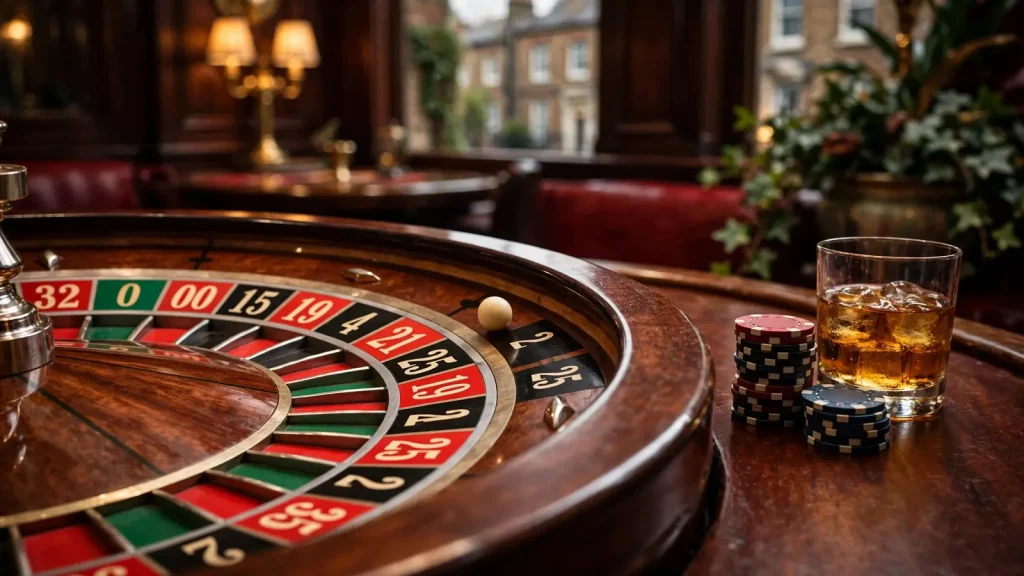
The double-zero pocket distinguishes American roulette and shapes how its live tables, bets and payouts compare with other versions.
Table of Contents
- The American Wheel’s Extra Green Pocket
- What a UK Casino Licence Means for Live Roulette
- A Physical Wheel, a Dealer, and a Slower Game
- How Bets Settle—and What the Payouts Cost
- Reading the American Roulette Table
- Why the Double-Zero Changes the Odds
- Real-Money Bets and the Limits of a Betting System
- Finding Roulette Among Live Casino Tables
- The Game Behind the Spin
- Thirty-Eight Pockets, One Extra Zero
- Jackpoty live casino
The American Wheel’s Extra Green Pocket
American roulette is identified by a small addition with a large visual presence: its wheel has two green pockets, marked 0 and 00. European roulette has one green pocket, marked 0. That extra symbol is the clearest way to distinguish the American version before any question of presentation, venue or play arises. The difference is not a new name for the same arrangement. It is part of what makes the American game American.
The green pockets sit apart from the wheel’s numbered red and black sequence in the imagination as much as in colour. Zero is already a conspicuous exception, a pause in the familiar alternation of red and black. The double zero makes that exception harder to overlook. It gives the American wheel a paired mark where the European wheel has a single one: 0, then 00. A modest graphic change, certainly. But games are often defined by precisely such details.
This matters when a casino offers more than one roulette variant. A label can say “American roulette”, yet the wheel itself supplies the most direct confirmation: the second green pocket is there, bearing the double zero. On a digital screen, the same distinction appears in the game’s representation of the wheel. The name and the visual detail should agree. Without the 00, the defining feature of American roulette has disappeared.
When choosing an online casino for American roulette in the UK, payout timing is one practical detail to consider. These verdicts note the payout-speed information available for each operator.
1. NightLuck
Payout speed: 1-3 business days NightLuck has a stated payout speed of 1–3 business days. This gives readers a clear timing detail to factor into their choice.
2. x3bet
Payout speed: 1-3 business days x3bet lists a payout speed of 1–3 business days. That is the available practical detail for considering this operator.
3. Chanze
Payout speed: 1-3 business days Chanze has a stated payout speed of 1–3 business days. Readers can use this timing information when weighing their options.
4. Amunbet
Payout speed: 1-3 business days Amunbet lists payouts as taking 1–3 business days. This provides a useful timing point to consider.
5. BeOnBet
Payout speed: 1-3 business days BeOnBet has a stated payout speed of 1–3 business days. This is the available detail to keep in mind when considering the operator.
6. SlotoSport
Payout speed: 1-3 business days SlotoSport lists a payout speed of 1–3 business days. This gives readers a stated estimate for payout timing.
7. SpinFormula
Payout speed: 1-3 business days SpinFormula has a stated payout speed of 1–3 business days. This timing detail may help inform a reader’s choice.
8. Zombillion
Payout speed: 1-3 business days Zombillion lists payouts as taking 1–3 business days. That is the available factual point about the operator.
9. Britsino
Payout speed: 1-3 business days Britsino has a stated payout speed of 1–3 business days. Readers can factor this timing information into their decision.
10. NightWin
Payout speed: 1-3 business days NightWin lists a payout speed of 1–3 business days. This offers a clear timing detail to consider.
The difference is easy to reduce to a piece of interface design, especially online, where a wheel may be encountered as an image rather than as an object in a room. But the image is not incidental. It tells the player which version is being presented. In that sense, the green pocket is doing work beyond decoration. The double zero is a label built into the game’s central object.
That is why the distinction deserves attention before any closer examination of the table or the rules. American and European roulette share the broad identity of roulette, but their wheels do not carry the same set of green markers. One has a single zero pocket; the other has both 0 and 00. The American version is not simply roulette with a different setting or a different screen. Its extra pocket belongs to the game’s visible structure.
For anyone comparing American roulette casinos in the UK, this is a useful first point of reference, not a verdict on a casino. An online American roulette casino may present the game through a digital interface, but the version remains recognisable by its double zero. The same check applies whether the game is described as American roulette online or offered among other roulette choices: the defining question is what the wheel shows. Labels can be brief; the symbol is specific.
There is a quiet neatness to the contrast. European roulette gives green to one pocket, 0; American roulette gives it to 0 and 00. A single character is repeated, then doubled, and the game’s identity shifts with it. No dramatic flourish is required. The extra mark is enough.
The colours also make the difference legible without demanding a long explanation. Red and black carry the familiar visual rhythm; green interrupts it. In the American version, that interruption appears twice. The double zero is therefore both a number and a sign: it identifies the version at a glance. Its presence is not a footnote to the name but the detail that gives the name substance.
Live Casino Lightning Roulette in the UK
Online, the distinction can be obscured by familiar menus and similar-looking game titles. The words “American roulette” may sit beside several other options, but the meaningful difference is not in the surrounding menu. It is in the wheel’s two green pockets. For a reader seeking an American roulette casino online, that is the feature that separates this version from European roulette, even when both are presented on the same kind of screen.
The comparison should remain precise. European roulette has one green pocket, 0; American roulette has two, 0 and 00. That statement is enough to establish the contrast without confusing it with other questions about how a particular game is presented. A second zero may occupy only a small part of the display, but it changes the wheel’s signature.
There is something almost bureaucratic about the distinction: one mark entered twice, and a separate version is born. The wheel does not need a new colour scheme or a different name for every number. It needs only that additional green pocket. Small change. Clear identity.
What a UK Casino Licence Means for Live Roulette
When a casino offers live American roulette to people in Great Britain, the question of who may lawfully provide it comes before questions of presentation or preference. A remote gambling operator taking customers in England, Scotland or Wales must hold the relevant licence from the UK Gambling Commission. That requirement applies whether the operator is based locally or abroad. The address of a company does not move the boundary of the British market.
This gives “licensed” a specific meaning. It is not a decorative assurance attached to a casino’s name, nor a substitute for comparing what its tables offer. It identifies the regulatory system under which the operator is permitted to provide gambling to customers in Great Britain. Live dealer casinos are legal in the UK when they hold a UK Gambling Commission licence. A site serving British players without the required licence is outside that system, even if it is accessible online or displays permission from a regulator elsewhere.
French Roulette Online Casino UK: Rules and Play
The distinction matters because the word casino can suggest a building, a room, a familiar public institution. In remote gambling, the service crosses that threshold without the building: the operator arranges access to casino games online. The Gambling Act 2005 provides the framework for gambling in England, Wales and Scotland; Northern Ireland is not covered by that Act. The relevant licensing condition for remote operators serving Great Britain is therefore not a matter of where a roulette studio happens to be situated. It concerns the market the operator serves.
That is the regulatory ground beneath any choice among online casinos offering American roulette. A comparison of tables may consider whether the game is available, how the site presents it, or what other terms accompany play. None of those details replaces the basic legal condition. A casino can make an attractive display of a table, but presentation cannot confer permission to serve the market. A licence is the threshold, not the sales pitch.
The same principle applies to searches for the best American roulette casino in the UK. “Best” has no single legal definition, and the existence of a UK licence does not rank one licensed operator above another. It answers a narrower, more consequential question: whether the operator holds the authorisation required to offer remote gambling to customers in Great Britain. Treating that condition as a quality medal would confuse permission with preference. Treating it as irrelevant would be worse.
Nor does licensing turn the regulator into a curator of casino taste. A UK Gambling Commission licence does not, by itself, establish that a particular table is the right choice for every player, or that an operator’s promotions suit every account. Casino terms remain terms, and the label “licensed” should not be made to carry claims it does not make. It marks regulatory standing; it does not abolish the need to read the conditions attached to a service.
There is a small national story in this arrangement. Britain permits remote casino gambling, but does not treat permission as something an operator can simply import from another jurisdiction. The operator’s location may be elsewhere; its obligation to hold the relevant British licence follows the customers it serves. That is a practical form of territorial regulation, less visible than the roulette wheel and more decisive than its décor.
Attention: A site serving British players without a UK Gambling Commission licence is operating outside the legal regulatory system, regardless of where the operator is based.
The legal geography should also be described carefully. The Gambling Act’s reach is not the whole United Kingdom: it applies in England, Wales and Scotland, not Northern Ireland. Meanwhile, the licensing rule relevant to remote operators serving Great Britain is clear. A broad phrase such as “UK-licensed” is commonly used in conversation, but precision matters when the legal framework itself draws distinctions. The point is not to turn a casino choice into a constitutional seminar. It is to avoid making the licence sound broader or more mysterious than it is.
For anyone comparing online American roulette casinos, the useful first distinction is thus between an operator authorised for the British market and one operating beyond the UKGC system. The first meets the local licensing condition for serving Great Britain; the second does not become locally regulated merely by being reachable from a British screen. The law draws the line. It does not choose a favourite.
Gambling content is for entertainment purposes only and is not gambling advice.
A Physical Wheel, a Dealer, and a Slower Game
In live American roulette, the wheel is not an animation standing in for a result. A human dealer spins a physical wheel in a studio, while a camera carries the game to the screen in real time. The player follows the same unfolding event as everyone else at the table, but makes selections through an on-screen interface. The ritual is physical; participation is digital.
Live Roulette in the UK with English-Speaking Dealers
That distinction shapes the pace. Computerised roulette relies on a Random Number Generator to produce each result, with the sequence presented through software. In a live game, the dealer’s actions occupy the space between one opportunity to bet and the next: the wheel turns, the ball moves, and the result becomes visible. There is less of the instant reset that can make a digital version feel like a rapid sequence of separate clicks.
The delay is part of the format, not a technical fault. A live table proceeds at a slower pace than a digital game, because a person and a physical wheel set its rhythm. That can lend the game a recognisable casino atmosphere, though the screen remains a screen: the dealer is in the studio, not in the room with the player. The camera makes the event observable, not shared in quite the same way as standing around a table.
An American roulette live dealer game uses that same arrangement. The interface is where bets are entered, while the broadcast shows the dealer and wheel. In effect, the screen has two jobs: it conveys the action and provides the means to take part. This combination is why live dealer roulette can feel more social or ceremonial than a fully computerised game, even when the player is alone at home. The ceremony survives its journey through a data connection.
There are practical costs to that slower, more tangible format. Live games have higher minimum bets than their digital counterparts, and they need a stable internet connection to keep the stream and the betting interface in step. A disrupted feed is more than an aesthetic annoyance when a round is in progress; the format depends on the live image arriving reliably. That dependency is the price of watching the wheel rather than receiving a computer-generated result.
Live dealer games typically have higher minimum bets than digital versions and require a stable internet connection to maintain the live stream and betting interface.
The interface does not remove the ordinary need to understand what is being played. Table rules and the paytable should be reviewed before placing bets, and a spending limit is best set before a live session begins. Those are modest preparations for a game whose pace is slower but whose decisions still involve money.
The human dealer changes the texture of roulette, not its basic uncertainty. A real wheel gives each round a visible beginning and end, while the software behind a digital version keeps the process less theatrical. Neither format turns the outcome into something predictable. The studio offers presence, not foresight.
This page is for entertainment and is not gambling advice.
How Bets Settle—and What the Payouts Cost
A roulette wager is resolved by the ball’s final resting place. If it lands on a number covered by a bet, that bet wins; if not, the stake is lost. The result is simple. The cost of choosing one kind of wager over another is less visible, because it is expressed not only in the payout but in the house edge.
A straight-up bet selects a single number. It is the most exacting kind of selection: the ball must stop on that choice. Roulette’s stated house edge for a straight-up bet is 2.9%. Other bets carry a house edge of 2.7%. The difference is modest, but it matters when comparing wagers. A more narrowly targeted choice does not become better value merely because its result is easy to understand.
Live Dream Catcher Casino UK: Format Guide
The house edge describes the casino’s mathematical advantage over time, not a fee removed from every individual stake. One spin can produce a win or a loss, and a short run can look nothing like the longer-term calculation. The percentage is a measure of the wager’s structure, not a forecast of what will happen next. Chance is not obliged to keep tidy accounts.
That distinction helps explain why American roulette payouts should be read alongside the odds attached to each type of bet. A displayed return may look generous when a wager covers only one number, but the apparent reward has to be considered against the narrow chance of success and the stated edge. Bets covering broader outcomes have a different balance between how often they can win and what they return. The house edge remains the useful comparison: for roulette, the stated figure is 2.9% on straight-up bets and 2.7% on other bets.
For anyone learning how to play American roulette, the practical sequence is therefore not complicated: choose a wager, let the spin resolve, and see whether the ball lands on a number included in that wager. The difficulty lies less in the mechanics than in judging what a payout means. A winning result does not prove that a bet was favourable in the long run, just as a losing result does not show that a choice was irrational. Each spin is an outcome; the edge belongs to the game’s underlying arithmetic.
Before Placing Bets
- Review the table rules
- Check the paytable
- Set a spending limit
This is also why a player considering whether to play American roulette online in the UK should distinguish between the excitement of a particular result and the cost built into the wager. The same basic settlement rule applies across roulette: the selected outcome must match where the ball stops. The figures do not promise a return on any session, and no payout can make a losing bet retrospectively sound. The numbers are plain enough. Their implications are not.
Reading the American Roulette Table
An American roulette table is a betting interface as much as a picture of the game. Its central area presents numbered spaces for individual selections, while broader marked sections sit around the number field for grouped choices. The arrangement turns a complicated set of possible bets into something that can be read at a glance: a choice is made by locating a space, not by describing it to a dealer.
The detail that distinguishes the American layout is visible within that field. Alongside 0, it includes a separate space marked 00. The double-zero is not a label for a different kind of bet or a decorative symbol; it is another number available on the table. A player scanning the layout therefore has to treat 0 and 00 as distinct selections.
On a digital table, the same logic is translated into clickable or tappable areas. A selection may be placed directly on a numbered space or on a boundary or marked section, depending on the kind of bet offered. The interface records where the bet is placed, so precision matters: a chip sitting on a number does not mean the same thing as one resting across a boundary. The table is doing the work of a betting slip, with position carrying meaning.
Crazy Time Live Casino Game Show in the UK
The layout can look busy because several categories occupy the same surface. The numbered field is the most exact part; the surrounding labels collect numbers into wider groups. Some areas refer to colours, others to whether a number is odd or even, and others to ranges or sections of the field. These labels are not ornaments. They are the table’s shorthand for different ways of choosing, and their borders show which spaces a selection covers.
The green spaces deserve a separate glance. On an American table, both 0 and 00 are set apart from the red and black number spaces. That visual separation makes the added pocket legible before a bet is placed. It also prevents a familiar habit from taking over: reading only the coloured or numbered grid and overlooking the extra green entry.
The presentation may differ between a physical felt and a casino screen, but the essential task is the same: identify the intended area before committing a chip. A useful pause comes before placement, not after it. Check whether the marker is centred on one number or covers a broader marked region, and make sure that 00 has not been mistaken for 0. The table records location, not intention.
This is where the layout’s old-fashioned clarity meets modern software. Felt once made every choice visible to the people gathered around it; a screen preserves that map in a smaller frame. The American version adds one unmistakable coordinate. Easy to miss.
Why the Double-Zero Changes the Odds
The difference between American and European roulette is easy to overlook when attention is on the numbered betting spaces. The green pockets sit apart from the red and black numbers, and neither belongs to either colour. But their presence changes the chances attached to a selection: the American wheel has both 0 and 00, while the European wheel has only 0.
American Roulette
Features a wheel with thirty-eight pockets, including both 0 and 00.
European Roulette
Features a wheel with thirty-seven pockets, including only a single 0.
For a player selecting one number, the stated chance of winning is one in 38 on American roulette, compared with one in 37 on European roulette. The gap is not dramatic at the scale of a single spin. It is still a real difference: the same kind of selection has a slightly lower chance of landing successfully on the American wheel.
That extra green pocket does not announce itself as a new kind of game. The numbered field remains familiar, and the betting action may look much the same. The change is quieter than that. A second green result has been added to the set of possible outcomes, so a chosen number has one more way to lose. Green is not a neutral pause in the game; it is part of the arithmetic.
There is a useful distinction between seeing the double-zero and understanding its effect. On the physical wheel and in the table’s representation, 00 is visible beside 0. Once the result is considered, however, both pockets matter whether or not a particular bet draws attention to them. The wheel does not favour a number because it is popular, nor does the extra pocket wait for a special kind of wager. It simply belongs to the range of outcomes.
This is why the comparison is more meaningful than a visual inspection alone. A player could recognise the American double-zero wheel immediately and still fail to notice what it changes about the chance of a successful single-number pick. The figures make that consequence plain: one in 38 rather than one in 37. European roulette gives that selection a marginally better chance, because its wheel has one fewer green pocket.
Monopoly Live Casino UK: How Online Play Works
The difference also shows how a small design choice can carry financial weight without changing the ceremony of play. A wheel turns; a ball settles; the result is recorded. The appearance of a second zero may seem like a modest adjustment, but probabilities are made from precisely such details. The familiar colours and numbers create continuity, while the additional green pocket quietly shifts the balance.
This comparison concerns the chance of winning on a selected number, not a promise about what will happen in any particular spin. Each result is uncertain, and a run of outcomes cannot erase the underlying difference between the two versions. American roulette’s extra zero remains part of the wheel even when it has not appeared for a while.
A small pocket. A lasting distinction.
Real-Money Bets and the Limits of a Betting System
With real money on the table, roulette’s house edge is not a fee charged separately after a spin. It is built into the game’s payouts: across repeated play, the terms favour the house rather than the player. A run of wins can happen; so can a run of losses. Neither changes the underlying arrangement.
That distinction matters because staking systems often make a promise by implication. Martingale, for instance, calls for increasing a stake after a loss in an attempt to recover what has been lost when a win eventually arrives. The arithmetic can look orderly on paper. The money at risk does not remain orderly: each unsuccessful step requires a larger stake, while a continuing losing run can make those demands grow quickly. A system can therefore produce losses, not abolish them.
Betting Systems
A staking system like Martingale cannot remove the house edge and may quickly increase the amount of money at risk during a losing run.
No sequence of stakes changes the wheel or makes a previous result govern the next one. A betting pattern may determine how much is placed and when, but it cannot turn an unfavourable house edge into an advantage. Nor does a win prove that the system has worked in any lasting sense. It records a result, not a new rule.
American roulette betting options may differ in how much a player risks and what a successful selection pays, but they remain wagers made under the game’s terms. The choice between a modest stake and a more ambitious pattern is not a choice between risk and certainty. Real-money play makes that plain: each stake can be lost, and a strategy that asks for larger stakes after setbacks may expose more money in the effort to recover.
A budget set before play gives the session a boundary. Once it is reached, continuing in pursuit of losses—or extending play to press a win—moves beyond that boundary rather than repairing the result. This is not a flaw peculiar to one system. It is the point at which a plan for staking gives way to an attempt to make chance answer for what has already happened.
Real-money American roulette is gambling, not a reliable method of earning. A staking system can organise decisions, but it cannot remove the house edge or guarantee recovery. The distinction is unromantic, and useful.
This material is for entertainment purposes only and is not gambling advice.
Finding Roulette Among Live Casino Tables
Roulette is one part of the live-casino catalogue, rather than a separate kind of venue. In the same section of an online casino, it may appear beside baccarat and blackjack, with each game presented as a table to join. The practical question is not simply whether American roulette is offered, but what the listed table requires as an opening stake.
Deal or No Deal Casino UK: Slot Format Explained
A specialist review has reported live roulette tables with starting stakes around 20p. That is a source-specific indication, not a dependable market-wide price: table limits can be attached to particular offerings, and a figure reported in a review should not be treated as a standing promise across casinos. The comparison in that review also put baccarat in a similar entry range, while blackjack tables were described as beginning at higher stakes. A modest threshold on one table does not make every live table equally accessible.
That distinction matters because a catalogue can make games look interchangeable when their entry conditions are not. Roulette may be visible in the live section, yet the displayed minimum determines whether a particular table fits a chosen budget. The listed stake is therefore a more useful detail than a broad label such as “live casino”, which says little about the cost of joining.
American roulette may be included among the roulette options, but availability and affordability are separate questions. A table’s name identifies its game; its stated minimum sets the immediate boundary for participation. Neither should be inferred from the presence of roulette elsewhere in the same catalogue. The menus are not uniform.
Live tables also sit within a larger range of casino games, so browsing them is partly an exercise in distinguishing formats and their limits. The small reported entry figure is noteworthy precisely because it belongs to a particular account, not because it settles what every operator offers. A price is never a promise.
The Game Behind the Spin
Roulette has a remarkably plain sentence at its centre: the ball comes to rest on a number, and a player wins by having selected that number. Everything else—the wheel’s ceremony, the felt, the careful placing of chips—gives that sentence a public stage.
That simplicity helps explain the game’s long life. Its outcome is visible and singular. There is no hand to build, no sequence of cards to interpret, no opponent whose intentions must be read. The wheel turns; the ball settles; one number is named by what happens. For a moment, a room full of separate hopes is reduced to the same small question.
American roulette is a casino game built around that familiar result. The identity of a particular spin does not depend on a player understanding a complicated plot. A selection either corresponds to the number where the ball stops or it does not. The game’s drama comes from waiting for that correspondence to become clear, not from a story unfolding between one decision and another.
This is also why the game can look more elaborate than it is. The table invites choices, and the ritual encourages the impression that each choice is part of a wider strategy. But at the centre, the condition for a win remains direct: the selected number must match the ball’s destination. The ball does not know what was intended, and the wheel does not reward a compelling theory. The ceremony is human; the result is a number.
An online American roulette casino game preserves that same basic idea in a digital setting. The surroundings may change, but the central test does not: a chosen number and the number on which the ball lands must coincide. That is the whole hinge of the game.
There is a small social history in this simplicity. Roulette makes chance easy to watch together. People can follow the same moving ball without needing the same language, skill or explanation. Its rules turn uncertainty into a shared spectacle, then end it with a number that everyone can recognise.
The principle is simple. The waiting is not. This text is for entertainment purposes only, not gambling advice.
Thirty-Eight Pockets, One Extra Zero
An American roulette wheel has thirty-eight pockets: the numbers 1 to 36, plus 0 and 00. The extra green pocket is the reason the total differs from the European wheel, which has thirty-seven: its numbered pockets sit alongside a single 0.
That distinction is easy to overlook when the wheel is reduced to a picture on a screen. Yet the count is not decorative. It gives the American version its defining arithmetic: the stated chance of winning is one in thirty-eight, compared with one in thirty-seven on European roulette. The numbers name the same basic game, but the denominator changes with the wheel.
The two green pockets make the American count clear. Zero is not a spare label outside the sequence, and 00 is not another way of writing zero. Each occupies its own pocket. Together, they stand beside the numbered pockets and bring the total to thirty-eight. On the European wheel, only 0 occupies that green space, leaving thirty-seven pockets altogether.
This is a small difference in appearance and a precise one in arithmetic. The double zero belongs to the physical design, not to a special rule added after the wheel is made. Counting the pockets therefore answers the question directly: an American wheel has thirty-eight, while a European one has thirty-seven.
The figures describe the stated odds for the two versions; they do not promise what any particular spin will do. A wheel gives no memory to a number and no obligation to follow a pattern. It simply presents its pockets again.
Thirty-eight, not thirty-seven. That is the count.
This content is for entertainment purposes only and is not gambling advice.
How can you win live dealer roulette?
You win when the ball lands on a number you selected.
How does the house edge change between games?
In roulette, the stated house edge is 2.9% for straight-up bets and 2.7% for other bets. American roulette has 38 pockets, compared with 37 in European roulette.
Why does the dealer always win in blackjack?
The dealer does not always win: players aim to beat the dealer with a hand totaling 21 or less. Blackjack still retains a house edge.
Jackpoty live casino

Live Casinos in the UK: How Online Tables Work
Live casino games broadcast dealers and table play through an online interface, but the format...

Crazy Time Live Casino Game Show in the UK
A look at the studio-and-interface format, UK casino context and the limits of claims about...

Deal or No Deal Casino UK: Slot Format Explained
The guide distinguishes the familiar Banker-and-briefcase premise from slot features, bonus searches and what free...

French Roulette Online Casino UK: Rules and Play
French roulette combines a single zero with La Partage on eligible even-money bets, alongside live...
Live Baccarat Online in the UK: Rules and Tables
A practical look at live-table mechanics, betting costs, stream quality and the UK licensing context....

Live Blackjack Online Casinos in the UK: How It Works
A live dealer runs the physical game in a studio while players follow the stream...

Live Casino Lightning Roulette in the UK
A live stream connects a physical dealer and wheel to digital betting controls, while computerised...

Live Dream Catcher Casino UK: Format Guide
The guide separates the studio broadcast from software-led play and sets out practical points for...

Live Roulette in the UK with English-Speaking Dealers
A look at the live studio setup, betting interface, wheel formats and the limits of...

Monopoly Live Casino UK: How Online Play Works
The format pairs a real studio and dealer with screen-based wagers, while rules and availability...

European Roulette at UK Online Casinos: Rules and Play
A guide to European roulette’s single-zero wheel, betting options and the differences between online spins...
































































































































































































































































