
Crazy Time Live Casino Game Show in the UK
 Available in GB
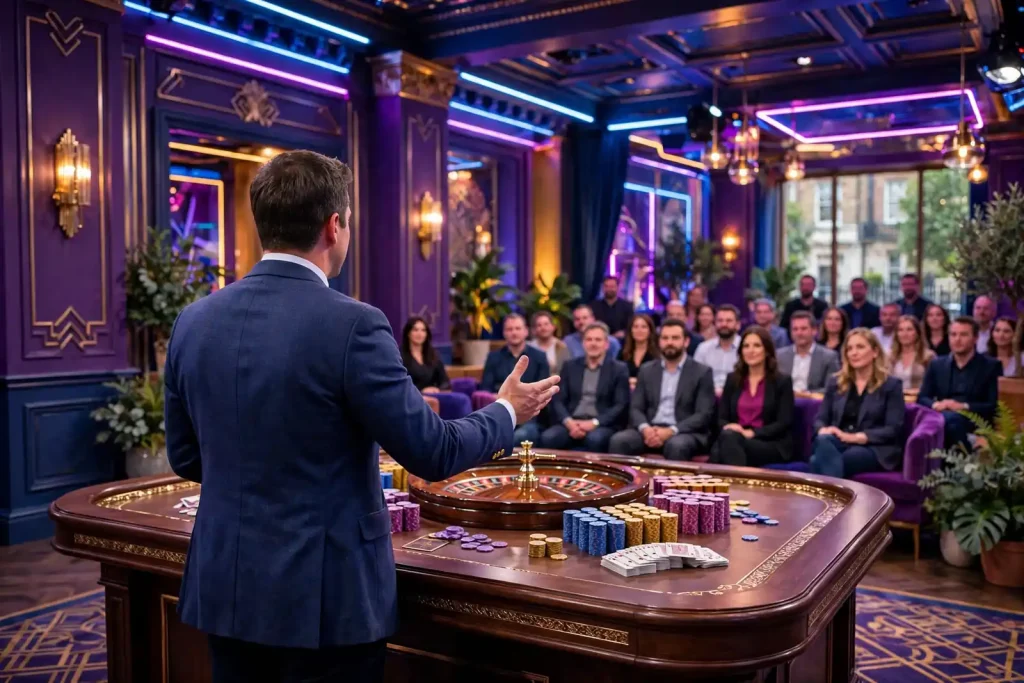
A look at the studio-and-interface format, UK casino context and the limits of claims about play, comparisons and bonuses.
Table of Contents
- The Live-Casino Setting Behind the Game
- Crazy Time in a UK Casino Context
- Casino Sites and the Limits of What Can Be Compared
- Where Live Casino Play Fits
- What “Best” Can Mean Without a Verified Shortlist
- Strategy Claims, History and the House Edge
- Demo Searches and the Limits of Live Play
- Free Play: What the Available Information Does Not Establish
- GamStop Searches and Unverified Casino Claims
- Bonuses, Free Spins and the Small Print
- Jackpoty live casino
The Live-Casino Setting Behind the Game
A live casino occupies an unusual middle ground. It is online, yet its central event is not generated entirely by software: a studio sends a real-time video feed of a human dealer, while players use an on-screen interface to place bets. The screen holds two kinds of activity at once. One is visible and physical; the other is digital, private to each player and governed by the buttons and selections in the interface.
That arrangement helps explain why a title such as Crazy Time is often considered within the live-casino world. The phrase “live casino” describes a format, not a promise that every game carrying the label has the same rules or presentation. At its simplest, the format joins a streamed studio event to an online betting window. The distinction matters: the dealer and the action are real-time, while the player’s participation is mediated by software.
The studio is not merely a decorative backdrop. It is where the public part of the game takes place, in view of the camera. The interface, by contrast, is where an individual makes a private choice about a bet. This division gives online gambling a theatrical quality without turning it into a theatre in the ordinary sense. There is a shared event on screen, but each player occupies a separate digital seat.
In a conventional digital casino game, the visual action is produced by the game software. In a live-dealer format, the central activity is streamed from a studio, with a human dealer present. The feed lets the event unfold as it happens; the interface allows bets to be submitted alongside it. The screen therefore does not simply display a result. It coordinates a broadcast and a transaction, two processes that have to meet at the right moment.
That coordination shapes the rhythm. Live games move more slowly than their digital counterparts. The pace includes the visible sequence of events and the time needed for bets to be placed through the interface. The difference can feel modest in a description and substantial in practice: a streamed game cannot compress every interval in the way a software-generated one can. There is a human tempo to it, even when the room itself is reached through a phone or computer.
Deal or No Deal Casino UK: Slot Format Explained
The studio also changes what “being present” means. Nobody sitting at home is physically beside the dealer, and the screen does not reproduce a room in full. Still, the live feed gives the game a visible point of origin: a person handles the play in a studio, while the audience watches remotely. It is a peculiar form of proximity, built from cameras, interfaces and distance. The casino has become a broadcast, but not quite a television programme; the viewer has an active betting panel.
That active panel is essential. Watching a stream alone would make the event a spectacle; the interface turns it into a playable session by letting participants make selections and place bets. The two layers should not be confused. The video carries what is happening at the table or studio, while the interface carries each player’s choices. A connection between them is necessary, which is why live play depends on a stable internet connection. A broken stream is not just an interruption to the picture; it can disrupt the timing that gives the format its shape.
There is also a practical difference in entry cost. Live games have higher minimum bets than digital versions. That changes who can comfortably take part and how long a session can feel sustainable. The slower pace and higher minimums are not incidental quirks of presentation: they are part of the conditions created by running a real-time studio game rather than a fully digital one. The human presence has a price in time and access.
In this setting, the appeal is not only the prospect of a game outcome. It is also the visible procedure: a dealer, a studio, an unfolding event, and a digital interface waiting for a decision. The format borrows something from broadcast entertainment and something from the old casino floor, then places both inside a screen. It does not erase the distance between the player and the dealer. It makes that distance part of the design.
Live Casino Format
A streamed studio event paired with an on-screen betting interface, typically featuring a slower pace and higher minimum bets than digital games.
For anyone encountering the phrase Crazy Time live casino, this wider format is the useful point of reference: live casino means streamed studio action paired with betting through an on-screen interface. The pace is slower, the minimum bets higher, and the connection has to hold. Those are not glamorous details. They are the machinery behind the spectacle.
Crazy Time in a UK Casino Context
“Crazy Time” has become a compact label for a particular kind of live-casino search: a named game encountered within the broader world of online gambling. The phrase may be written in several orders, with “casino” attached before or after the game’s name, but the underlying interest is much the same. It points towards a live-casino setting rather than a general question about casino games.
That distinction matters in Britain, where the legal status of a casino is not determined by the spectacle of its presentation. A studio, a dealer and a polished broadcast may make an online game feel close to a public gaming room; they do not, by themselves, establish that the operator may lawfully offer gambling to people in the UK. The relevant condition is regulatory, not theatrical.
Live-dealer casinos are legal in the UK when they hold a licence from the UK Gambling Commission. The rule applies to operators serving the British market, including those based elsewhere. A remote business does not avoid the licensing requirement by placing its studio or corporate address beyond the country. If it offers gambling to customers in Britain, its licence status is part of the legal framework in which that offer exists.
Live Dream Catcher Casino UK: Format Guide
There is a small but important difference between a game’s name and the authority under which it is offered. “Crazy Time casino” is often shorthand for the combination of a named game and an online venue. Yet the name alone says nothing about whether a particular operator is licensed. Nor does a game’s presence in a live-dealer category settle the matter. The operator is the regulated party; the game title is not a substitute for the operator’s legal standing.
This is one reason that phrases such as “UK Crazy Time casino” can be more ambiguous than they first appear. They might describe a British-facing service, a game being sought by someone in Britain, or merely a website using familiar UK language. Geography in a headline is easy to print. Regulatory status is a separate matter.
The UK Gambling Commission’s role belongs to the wider settlement around remote gambling. Britain permits online gambling through licensed and regulated operators, rather than treating a digital casino as a lawless extension of the internet. That approach places responsibility on businesses that make gambling available: the live format does not create an exemption, and the human presence on screen does not change who must hold the licence.
The distinction has a social dimension. A live broadcast borrows some of the cues of a shared room: a visible dealer, a real-time event and the sense that other people may be present. Online gambling, however, is still being delivered by a remote operator under a national regulatory system. The performance can suggest immediacy; the law concerns the business behind it. A studio is not a jurisdiction.
For that reason, “Crazy Time live casino UK” is best understood as a description of an intended context, not a legal guarantee. The words may identify what someone hopes to find, but they cannot certify the company providing it. A UK-facing live casino needs the appropriate UK Gambling Commission licence. Without that condition, the familiar look and language of a British casino do not make the service part of the regulated market.
Licensing Requirement
Operators offering live-dealer casinos to customers in the UK must hold a licence from the UK Gambling Commission to be lawful.
This is a narrower point than a judgement about any particular casino. It does not establish which venues carry Crazy Time, nor does it rank or endorse them. It sets the boundary that applies to live-dealer gambling in the UK: the licence belongs to the operator, and the operator must meet the local requirement. The game’s title can travel freely across websites; the legal permission cannot.
Casino Sites and the Limits of What Can Be Compared
A list of casinos said to carry Crazy Time would look useful at first glance. It would also make a claim about each named site: that the game is available there, in the version being discussed, at the time the list is read. Without confirmation of those details, ranking operators would turn an uncertain availability claim into a polished-looking verdict. A table can make almost anything appear settled.
The distinction that matters here is simpler than a site comparison. A live casino game is streamed from a studio, where a human dealer conducts play; bets are placed through an on-screen interface. A computer-generated casino game, by contrast, is produced digitally rather than shown as a live studio event. These formats may occupy the same casino website, but they are not the same kind of experience. The difference is not a matter of decoration.
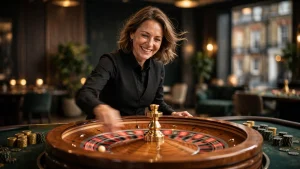
Roulette makes the distinction unusually visible. In live roulette, a dealer spins a physical wheel. Computerised roulette uses a Random Number Generator, or RNG, to determine the result. One presents a physical action through a real-time stream; the other generates its outcome electronically. Both can be offered online, and both can be called roulette, but the mechanism behind the result differs.
French Roulette Online Casino UK: Rules and Play
That comparison explains what “live” means in this setting. It does not establish how Crazy Time works, what its rounds contain, or which casino sites offer it. Those details should not be inferred from roulette, from a general description of live play, or from a page that happens to place several games under the same heading. The boundary is important: a format comparison is not a game specification.
There is a social history tucked into that distinction. Casinos have long used the visible dealer and physical table to make gambling feel like an event shared with other people, even when the participants are far apart. Digital games make a different promise: the machinery can reproduce a casino outcome without staging the table itself. Neither format becomes more reliable merely by looking more human. The stream shows a live process; the electronic version relies on a generated one. Appearance and mechanism are separate questions.
For anyone comparing sites, the useful question is therefore not which one has the most confident description. It is whether the claimed game and format are clearly identified, and whether the information actually supports the claim being made. A site list without that distinction can blur a live studio game with a computer-generated one, or imply availability that has not been established. That is not a small editorial shortcut. It changes what the list says.
The phrase “Crazy Time casino sites” can suggest a neat catalogue, perhaps followed by a winner at the top. But a comparison needs comparable evidence: the same game, the same relevant conditions, and current confirmation of availability. A ranking cannot supply those foundations by itself. Nor can an attractive label prove that a game is live rather than digital. The label is only a beginning.
Live Casino
Action is streamed from a studio with a human dealer and physical equipment.
Digital Casino
Results are produced entirely by software using a Random Number Generator (RNG).
The same restraint applies to descriptions of scores or outcomes. A live stream can show a game unfolding in real time, but that does not make a list of past results a guide to what comes next. The physical wheel in roulette and the RNG in computerised roulette describe different ways results are produced; neither comparison supports claims about Crazy Time results. Treating them as interchangeable would be a category error.
So a site comparison is meaningful only when it says precisely what is being compared and what is known about the format. Without that, the safest distinction is also the clearest one: live play is presented as an unfolding studio event, while computer-generated play is produced electronically. The rest requires evidence, not a leaderboard.
Where Live Casino Play Fits
A live casino is one part of an online casino’s wider menu, alongside games run entirely by software. Its defining difference is the pace: a human dealer conducts the action on a real-time stream, while participants use an on-screen interface to place bets. For anyone looking to play Crazy Time live, that distinction matters more than the label attached to a lobby category. A live game is not simply a digital game with a video window added; it depends on a broadcast and unfolds according to the dealer’s pace.
Monopoly Live Casino UK: How Online Play Works
A casino’s game catalogue is the practical starting point for finding a particular title. Live games may be grouped together or separated by type, but the organisation of a lobby does not establish that every game appears in every catalogue. A search for the Crazy Time wheel, or for a place to play the game in the UK, therefore leads to a simple condition: the title has to be listed by the casino being considered. A category name is not a guarantee of availability.
The format also asks more of a connection than a wholly digital game does. A stable internet connection is needed for the stream to remain usable; interruptions can make it harder to follow an event taking place in real time. The screen is part of the table. Without a steady picture, the sense of shared timing that distinguishes live play becomes less convincing.
There is a difference in pace, too. Live games generally move more slowly than digital versions because events are presented as they happen rather than resolved instantly by software. That can make the experience feel more social and legible, but it also means a session takes its rhythm from the broadcast. The waiting is built in.
Do
- Ensure a stable internet connection for the stream
- Account for the slower pace of live play
- Check the minimum stake requirements
Don’t
- Expect instant resolution like digital games
- Assume a stable picture is a guarantee of play
- Ignore the difference in entry costs
Minimum bets are higher in live games than in digital versions. This is a practical distinction, not a judgment about which format is better. It affects whether a live table fits a player’s intended spending limits, and it is one reason that the word “live” should not be treated as a purely visual preference. The stream may make a game feel closer to a physical casino; the table conditions remain part of the decision.
Online casino menus often place live play beside other formats, making the choice appear like a matter of taste. In reality, the formats ask for different things: a reliable connection, tolerance for a slower pace and an appropriate minimum stake. The technology offers a view of a human-run table, not a way to remove the constraints of one.
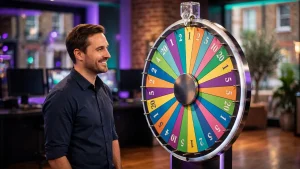
A wheel on screen can suggest immediacy. The broadcast says otherwise.
What “Best” Can Mean Without a Verified Shortlist
When exploring Crazy Time live casino options in the UK, payout timing is one practical detail to consider. The entries below include the payout information available for each operator.
1. NightLuck
Payout speed: 1-3 business days NightLuck has a stated payout speed of 1–3 business days.
2. x3bet
Payout speed: 1-3 business days x3bet has a stated payout speed of 1–3 business days.
3. Chanze
Payout speed: 1-3 business days Chanze has a stated payout speed of 1–3 business days.
4. Amunbet
Payout speed: 1-3 business days Amunbet has a stated payout speed of 1–3 business days.
5. BeOnBet
Payout speed: 1-3 business days BeOnBet has a stated payout speed of 1–3 business days.
6. SlotoSport
Payout speed: 1-3 business days SlotoSport has a stated payout speed of 1–3 business days.
7. SpinFormula
Payout speed: 1-3 business days SpinFormula has a stated payout speed of 1–3 business days.
8. Zombillion
Payout speed: 1-3 business days Zombillion has a stated payout speed of 1–3 business days.
9. Britsino
Payout speed: 1-3 business days Britsino has a stated payout speed of 1–3 business days.
10. NightWin
Payout speed: 1-3 business days NightWin has a stated payout speed of 1–3 business days.
“Best” can suggest a league table, but a ranking is only useful when its entries are judged on comparable terms. For a live-casino game, that might mean looking at the rules, how a round unfolds, the information shown on screen and the conditions attached to play. Those details matter more than a string of praise. A polished presentation, on its own, says little about the terms of a game.
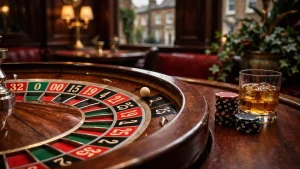
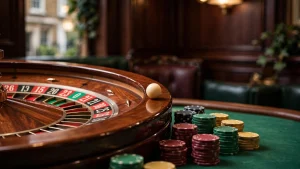
That distinction is easy to see in roulette, where a small change to the wheel alters the odds. American Roulette has two green pockets, marked 0 and 00; European Roulette has one, marked 0. The chance of a winning result is 1 in 38 on the American wheel and 1 in 37 on the European one. The difference comes from the layout, not the dealer’s style or the look of the table.
These are roulette rules, not specifications for Crazy Time. The comparison is useful for a narrower reason: a game’s familiar name does not settle what its rules mean. The same care applies when a game is described as a live casino favourite, a show or even a slot. Labels are shorthand; the actual format and rules do the work. A search for a “best” version cannot replace those details.
Results have a similarly limited role. A record of earlier outcomes can describe what has happened, but it does not turn past results into a dependable prediction of what comes next. A sequence may look suggestive because people are good at finding patterns, especially when money and anticipation are involved. That is not the same as a rule of play. Nor does a results tracker establish that one casino, table or game is better than another.
Live Baccarat Online in the UK: Rules and Tables
The word “strategy” can also be made to carry too much. A method may organise decisions or help someone keep within a personal budget; it cannot make an unsupported claim about how a particular game works true. For Crazy Time, a responsible description stays with what can be established about its format and rules, rather than borrowing tactics from unrelated games or presenting an invented system as an edge.
For anyone weighing claims of quality, the useful questions are ordinary ones: are the rules clear, is the game’s format accurately described, and are the conditions of play visible before a bet is placed? Those checks offer firmer ground than a bare superlative. A ranked list can look decisive. The detail beneath it matters more.
This article is for entertainment purposes only and is not gambling advice.
Strategy Claims, History and the House Edge
Advice presented as a Crazy Time strategy can sound precise without being specific to the game. A staking pattern, a sequence of past outcomes or a confident explanation of when to place a bet may be dressed up as a method. The important distinction is between a claim that describes a verified game rule and one that promises an advantage. A familiar label does not establish that a system changes the odds.
Attention: Staking patterns or past outcome trackers do not change the underlying odds or guarantee a win.
The same caution applies to accounts of the game’s history. A date, origin story or explanation of why a feature was introduced needs evidence that relates to Crazy Time itself. General stories about casino games cannot fill that gap. Nor does repetition turn a claim into a fact. Casino history is often told as a neat line from invention to modern entertainment; the real record is less obliging, and a polished narrative is not proof.
Tracking records have a narrower use. They can show what has already happened, if the information recorded is accurate. They do not make past results a reliable guide to future outcomes, and a tracker should not be treated as a device for finding a pattern that guarantees a win. Numbers in a table can look persuasive simply because they are arranged neatly. Neatness is not prediction.
Blackjack offers a useful comparison, but not a description of Crazy Time. Blackjack retains a house edge, and a staking system such as Martingale can still result in losses. Changing the size of a stake does not remove the underlying risk. The comparison is limited: blackjack has its own rules and decisions, and its strategy discussions cannot be transferred wholesale to another game.
That boundary matters because casino advice often travels more easily than the games it claims to explain. A familiar system can be repeated across different formats as though the same logic applies everywhere. It does not follow that a method discussed for blackjack, roulette or another table game has any relevance to Crazy Time. A claim needs support from the rules and mechanics of the particular game, not merely the authority of a confident voice.
Live Casino Lightning Roulette in the UK
A sensible account of strategy therefore separates description from promise. Describing a rule is not the same as identifying a reliable way to profit; recording results is not the same as forecasting them; and a game’s history is not a betting method. Where those distinctions disappear, certainty is doing more work than evidence.
The house edge is an uncomfortable reminder that casino play is not made safe by a clever-sounding system. Even a strategy with a name and a tidy rationale can leave losses possible. That is not a special finding about Crazy Time, nor a verdict on any particular betting approach for it. It is a reason to treat claims about advantage with care, and to keep the comparison with other games firmly bounded.
Demo Searches and the Limits of Live Play
A search for a leading Crazy Time casino can sound like a request for a simple league table. Yet “top” has no fixed meaning on its own. It might refer to a site’s range of live games, its terms, or the way its service is presented; without a clear measure, a ranking would give a neat order to a question that has not been defined. A polished list is not necessarily a useful one.
The same caution applies to advice labelled as Crazy Time tips. General observations about casino play do not automatically become game-specific guidance, and a confident headline cannot supply details about how a particular game works. The name “slot” in a search phrase can also blur a distinction: a live-dealer game is not described by the format of a conventional computer-generated slot simply because the two are placed in the same broad casino category.
The Role of the Interface
The on-screen interface is what turns a broadcast spectacle into a playable session, allowing participants to make selections and place bets in real time.
The defining feature of live play is the real-time stream. A human dealer operates in a studio, while participants use an on-screen interface to place bets. The image is not merely an animation standing in for a table; the action is presented as it happens. That makes the interface part of the experience, but it does not, by itself, answer questions about what a particular site offers or how a particular game behaves.
“Demo” is a label, not a description detailed enough to settle those questions. It does not establish whether a live stream is available without payment, whether an interface is simulated, or whether any activity could produce a real-money return. Nor does the phrase “live casino demo” prove that a particular Crazy Time version can be tried in that way. The distinction matters: seeing a game described as live is not the same as having evidence about a free-play mode.
There is a small theatre in the word “live”. It suggests immediacy, and the studio stream does provide a human presence and unfolding action. But that atmosphere cannot turn an unverified demonstration into a confirmed product feature. A screen can show a dealer; the word demo can promise less, or more, than the screen actually provides.
So a search for a top UK venue or a Crazy Time demonstration reaches two separate questions: what the live format entails, and what an individual casino makes available. The first has a clear outline—studio stream, human dealer, bets through an on-screen interface. The second needs specific information about the offer itself. They are not interchangeable.
Free Play: What the Available Information Does Not Establish
A free version of Crazy Time and free spins connected with the game are separate possibilities, not interchangeable descriptions. A free-play mode would mean taking part without staking cash; free spins would be a promotional feature with its own conditions. Neither should be treated as a confirmed feature of Crazy Time.
European Roulette at UK Online Casinos: Rules and Play
That distinction matters because “free” can describe several different things. A game might be available to explore without a cash stake, or an offer might grant spins for a particular game. Those arrangements do not establish that a live game can be played without payment, and they do not make any winnings payable. Free access, where it exists, is not a promise of real-money returns.
Reviews need the same careful reading. A review of a casino or live game may describe the experience, but its title alone does not confirm that Crazy Time has a free mode or that a promotion includes spins for it. Promotional wording can also refer to slot games rather than live tables. The useful detail is the stated game, the way the offer works and any restrictions attached to it—not the broad label “free”.
The same caution applies to claims about safety. Free play is not a measure of whether a casino is safe, and a polished review is not a substitute for a regulatory check. In the UK, an operator offering online casino gambling to British customers must hold the relevant UK Gambling Commission licence. That requirement concerns the operator’s legal status; it does not establish that a particular free-play feature or promotion is available.
There is a small but important difference between absence of a cash stake and absence of risk. A no-cost mode, if offered, may let someone become familiar with a game, but it cannot be assumed to reproduce every condition of paid play. Nor should it be confused with an offer that requires a deposit or has terms attached. The word “free” does a great deal of work in advertising. It does not do the accounting.
Summary of Free Play
- Free-play modes and free spins are separate possibilities, not interchangeable
- Free access does not guarantee real-money returns
- Promotional “free” labels often apply to slots rather than live tables
- A free mode is not a substitute for a regulatory license check
This is entertainment content, not gambling advice.
GamStop Searches and Unverified Casino Claims
The phrase “not on GamStop” describes a relationship with a self-exclusion programme; it does not, by itself, establish what a casino offers or whether it is authorised to serve people in Britain. A game title attached to that phrase does not settle the matter either. Crazy Time may appear in searches alongside claims about casinos outside GamStop, but such wording is not proof that a named operator carries the game or has a particular status.
The distinction matters because GamStop and gambling regulation are not interchangeable. Remote operators selling gambling to customers in Great Britain must hold the relevant UK Gambling Commission licence. That requirement applies whether an operator is based in Britain or elsewhere. A claim that a casino is “not on GamStop” says nothing on its own about whether it holds that licence.
The UK framework treats the operator, not the game’s branding, as the regulated party. A live game can be presented as part of an online casino, but the name of a studio or game does not certify the casino hosting it. Nor does a label such as “non-GamStop” establish that the site is a lawful option for British customers. These labels compress separate questions into one convenient phrase. Convenience is not evidence.
This also leaves little room for an honest catalogue of Crazy Time casinos outside GamStop. Naming operators as examples would imply confirmed availability or status, neither of which follows from the label alone. The same caution applies to claims about an “Evolution casino”: a provider reference is not a substitute for identifying the licensed operator and the terms under which it serves the British market.
For anyone concerned about self-exclusion, the practical meaning of the programme is more important than a casino’s marketing description. A site’s relationship to GamStop should not be inferred from its game menu, its country of registration or a search-result headline. Licensing and self-exclusion are distinct matters, and neither can be reliably established by attaching a popular live game’s name to a slogan.
Bonuses, Free Spins and the Small Print
A Crazy Time casino bonus can sound like a straightforward way to join a live table, but the label “welcome offer” often points elsewhere. A specialist review of UK casino promotions describes many welcome offers as free spins on slots, which cannot be used at live tables. The distinction is practical: a bonus tied to slot play is not automatically a balance available for every game on the site.
The same separation matters when an offer includes wagering requirements. These set conditions for turning bonus funds or related winnings into withdrawable money, and the games played may count differently towards them. Live casino games can receive only a small share of the required contribution; one stated example is 10% weighting. A session at a live table may therefore move a bonus requirement forward much less than slot play, even when both are available at the same casino.
The terms, rather than the promotion’s headline, determine what can be played and how play counts. They may specify eligible games, contribution rates and restrictions on bonus funds. Those details can make a general casino welcome offer unsuitable for a live game, without changing the game itself.
A deposit bonus and a no-deposit offer are different arrangements, but neither name guarantees that the funds apply to Crazy Time. Nor does a bonus say anything by itself about casino payouts: withdrawal conditions and bonus rules are separate matters. A promotion mentioning a casino’s games should not be read as a promise that every game qualifies.
The small print is the actual offer. Live play and bonus play can occupy different corners of the same account, connected by conditions that are easy to overlook and consequential once wagering begins. Free spins remain spins for slots, not a general currency for the live table. This content is for entertainment purposes only, not gambling advice.
Jackpoty live casino
Live Casinos in the UK: How Online Tables Work
Live casino games broadcast dealers and table play through an online interface, but the format...

Deal or No Deal Casino UK: Slot Format Explained
The guide distinguishes the familiar Banker-and-briefcase premise from slot features, bonus searches and what free...
French Roulette Online Casino UK: Rules and Play
French roulette combines a single zero with La Partage on eligible even-money bets, alongside live...
Live Baccarat Online in the UK: Rules and Tables
A practical look at live-table mechanics, betting costs, stream quality and the UK licensing context....

Live Blackjack Online Casinos in the UK: How It Works
A live dealer runs the physical game in a studio while players follow the stream...

Live Casino Lightning Roulette in the UK
A live stream connects a physical dealer and wheel to digital betting controls, while computerised...
Live Dream Catcher Casino UK: Format Guide
The guide separates the studio broadcast from software-led play and sets out practical points for...
Live Roulette in the UK with English-Speaking Dealers
A look at the live studio setup, betting interface, wheel formats and the limits of...

Monopoly Live Casino UK: How Online Play Works
The format pairs a real studio and dealer with screen-based wagers, while rules and availability...
Online American Roulette in the UK: Wheel and Odds
The double-zero pocket distinguishes American roulette and shapes how its live tables, bets and payouts...
European Roulette at UK Online Casinos: Rules and Play
A guide to European roulette’s single-zero wheel, betting options and the differences between online spins...
































































































































































































































































